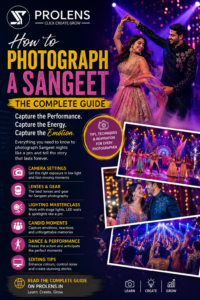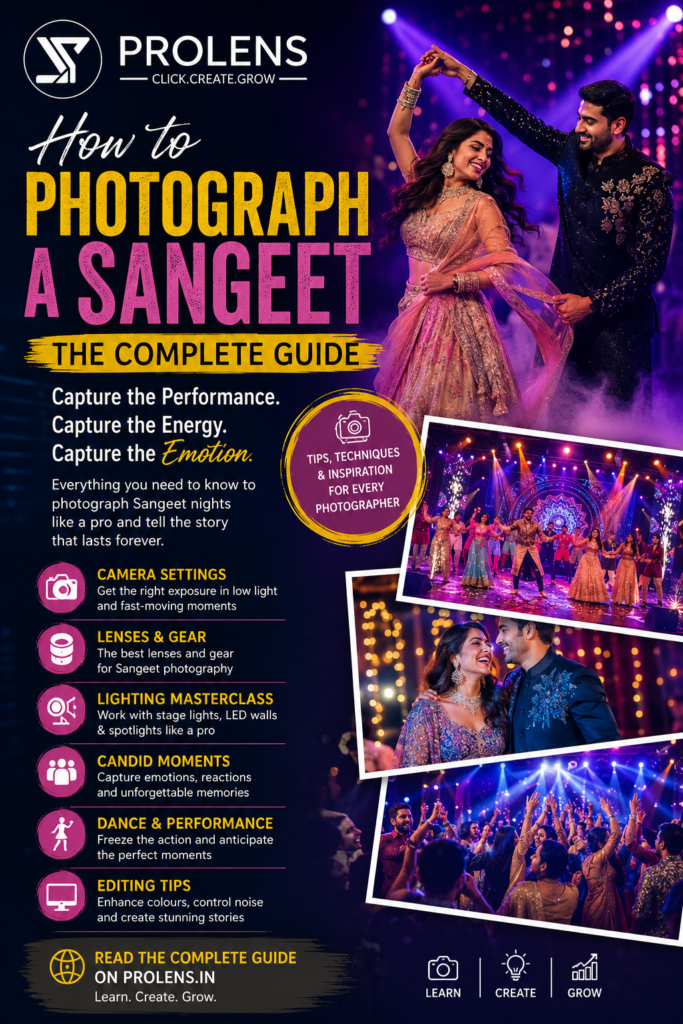
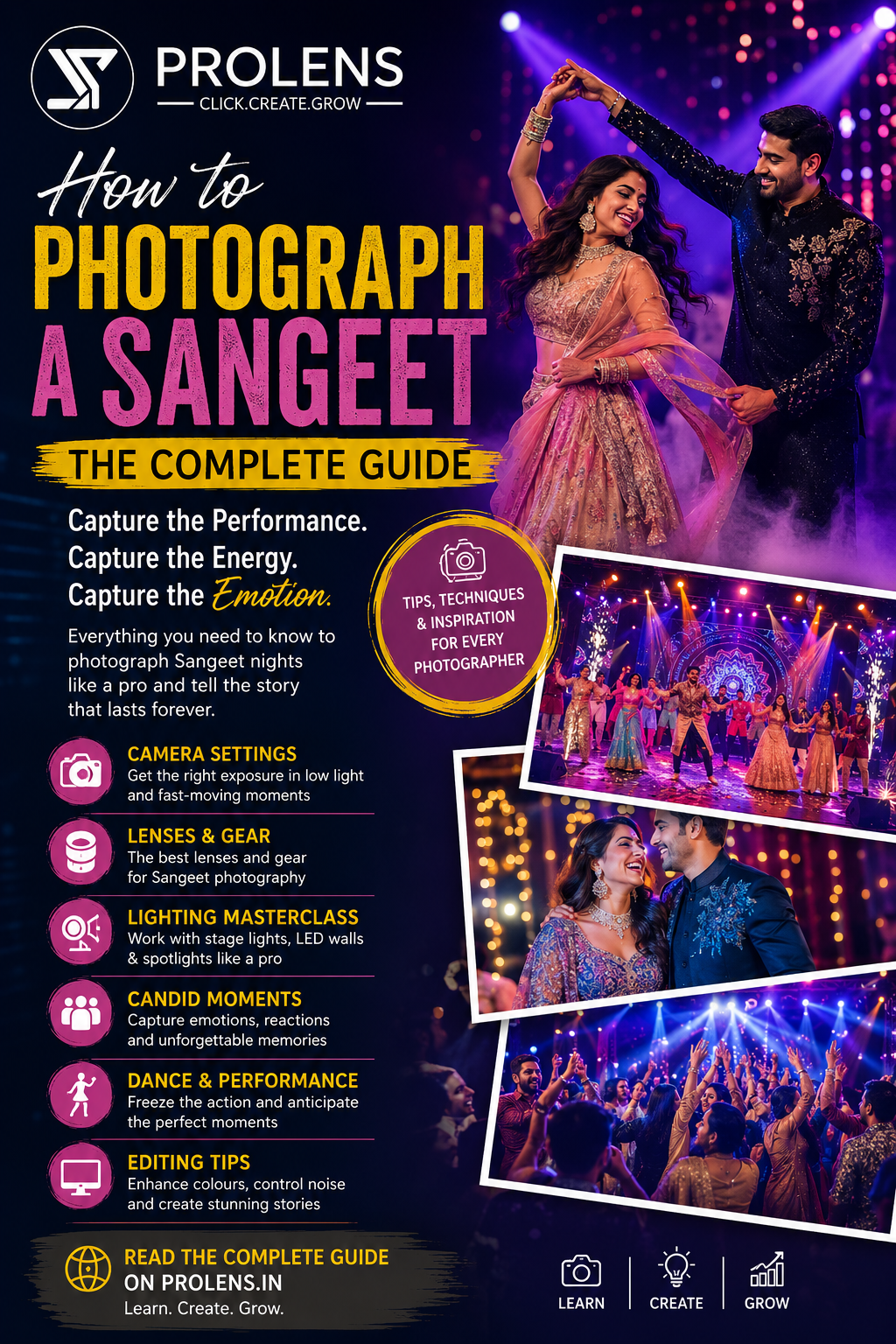
Capture the Performance. Capture the Energy. Capture the Emotion.
The Sangeet is one of the most exciting events to photograph during an Indian wedding. Music, dance performances, dramatic stage lighting, colourful outfits, emotional family moments and high-energy celebrations combine to create extraordinary photographic opportunities.
It is also one of the more technically demanding wedding events to photograph.
Low light, rapidly changing LED colours, moving subjects, spotlights, crowded dance floors and unpredictable performances can challenge even experienced photographers.
This complete guide from PROLENS – Click. Create. Grow. explains how to prepare, choose camera settings and lenses, work with stage lighting, photograph dance performances, capture candid reactions and create a compelling visual story of the Sangeet.
1. Understand the Sangeet Schedule Before You Shoot
Unlike many wedding ceremonies, a Sangeet often follows a planned performance schedule.
Speak to the couple, wedding planner, choreographer or event manager before the programme begins.
Find out:
- When the bride and groom will enter
- Whether there are separate family entrances
- The order of performances
- Who is performing for whom
- Whether the couple has a special performance
- When speeches or emotional presentations are scheduled
- Whether there are surprise performances
- When the dance floor opens
- Whether special effects are planned
Knowing the programme allows you to anticipate important moments instead of constantly reacting to them.
Preparation gives you position. Position gives you the photograph.
2. Scout the Venue Before Guests Arrive
Reach the venue early.
Walk around the stage and identify the best shooting positions.
Check:
- Stage height
- Stage width
- LED screen locations
- Speaker positions
- Lighting rigs
- Entry routes
- Couple seating
- Audience seating
- Dance floor
- Possible elevated shooting positions
Also look for obstacles that may block your frame once the event begins.
A few minutes of scouting can save you from discovering halfway through an important performance that a speaker or lighting stand is directly in your composition.
3. Photograph the Venue Before the Crowd Arrives
The décor team may have spent hours or even days designing the Sangeet venue.
Photograph it before guests enter.
Capture:
- Full-stage photographs
- Dance floor
- Lighting design
- Floral décor
- Table settings
- Couple seating
- Entrance décor
- Signage
- Decorative installations
- DJ console
- Musical elements
- Venue exterior
These establishing photographs provide valuable context when creating the final wedding album or film.
4. Best Camera Settings for Sangeet Photography
Sangeet photography usually involves low light combined with fast movement.
Your priority should therefore be achieving a shutter speed fast enough to freeze movement while maintaining acceptable exposure.
A practical starting point could be:
Shutter Speed: 1/250–1/500 sec
Aperture: f/1.8–f/2.8
ISO: Approximately ISO 1600–6400 depending on the camera and lighting
Autofocus: Continuous AF / Servo AF
Drive Mode: High-speed continuous
Metering: Evaluative/Matrix
File Format: RAW or RAW + JPEG
These are starting points rather than fixed rules.
For fast dance performances, you may need 1/500 sec or faster.
For slower emotional moments or speeches, you may be able to work at 1/160–1/250 sec.
Modern cameras perform remarkably well at higher ISO settings. A sharp photograph with some noise is generally preferable to a clean but blurred photograph.
5. Watch Your Shutter Speed
One of the most common mistakes in Sangeet photography is using a shutter speed that is too slow.
A performer may appear relatively still through the viewfinder, but hands, hair and clothing can move extremely quickly during a dance.
For energetic performances, try:
1/320 sec – moderate movement
1/500 sec – fast dancing
1/800 sec or faster – jumps and very rapid movement
Don’t be afraid to increase ISO if that is necessary to maintain your shutter speed.
Sharp emotion beats technically perfect noise levels.
6. Best Lenses for Sangeet Photography
A Sangeet requires a combination of wide environmental photographs and tight emotional images.
24–70mm f/2.8 – The Essential Workhorse
This is one of the most versatile lenses for Sangeet photography.
Use it for:
- Stage performances
- Couple entries
- Family photographs
- Medium portraits
- Dance-floor photographs
- Environmental images
70–200mm f/2.8 – Capture Expressions From a Distance
This lens is particularly valuable when you cannot stand close to the stage.
Use it for:
- Tight performance photographs
- Couple reactions
- Parents watching performances
- Emotional audience moments
- Close portraits
35mm Prime – Tell the Bigger Story
A fast 35mm lens is excellent for low-light environmental photography.
Use it to include performers, stage lighting and the audience within a single composition.
50mm or 85mm Prime – Low-Light Portraits
Fast primes provide excellent subject separation and allow you to work in extremely low light.
They are particularly useful for portraits and candid photographs between performances.
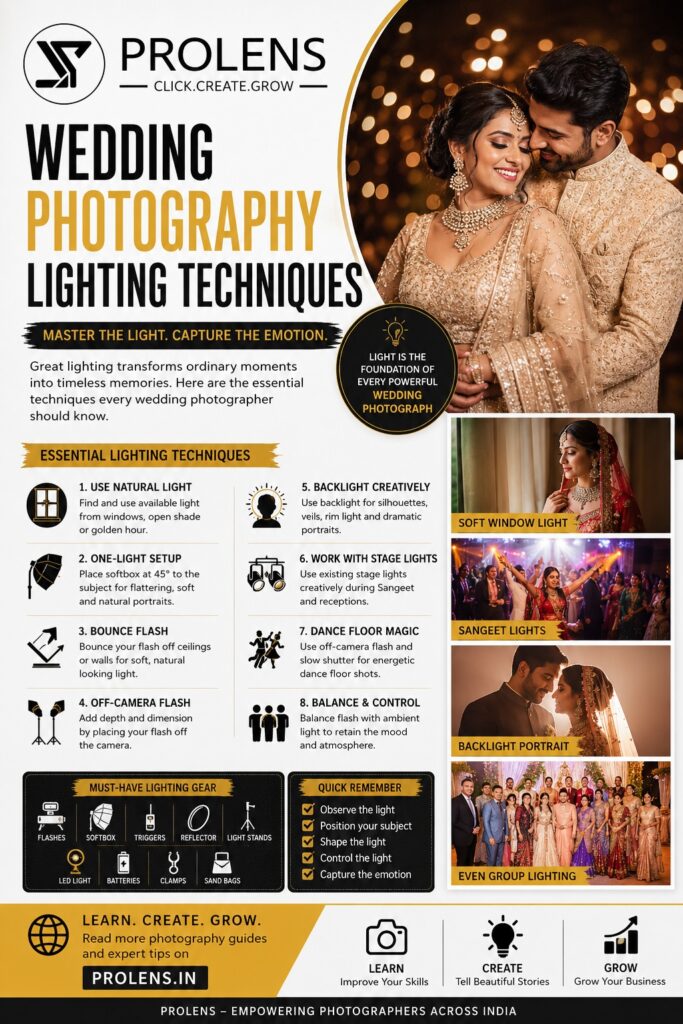
7. Working With Difficult Stage Lighting
Modern Sangeet venues often use sophisticated LED lighting.
Unfortunately, what looks dramatic to the human eye can be difficult for a camera.
You may encounter:
- Red light
- Blue light
- Magenta light
- Moving spotlights
- Strobes
- LED screens
- Lasers
- Rapidly changing colour temperatures
Avoid trying to correct every colour change while shooting.
Shoot RAW and concentrate on:
Exposure, focus, composition and timing.
White balance and colour can be refined later.
8. Protect the Highlights
Spotlights can create extremely bright areas on a performer’s face while the surrounding stage remains dark.
If you expose entirely for the background, faces may become overexposed.
Monitor your histogram and highlight warnings.
When necessary, slightly underexpose to protect important facial highlights.
RAW files generally provide significant flexibility for recovering shadow information during editing.
9. Photograph the Couple’s Entry
The Sangeet entrance is often carefully choreographed and may include:
- Dancers
- Cold pyrotechnics
- Flower showers
- LED effects
- Smoke
- Family members
- Live musicians
Coordinate with your team before the entrance.
Ideally, have one photographer capture a wide view while another concentrates on expressions.
Get the essential photographs first.
Experiment only after you know you have the safe shots.
10. Photograph Dance Performances Like a Story
Don’t photograph an entire dance performance from one position.
Build a sequence.
Capture:
The Opening
A strong wide photograph showing the performers and stage.
Individual Expressions
Use a telephoto lens for faces and gestures.
Group Formations
Photograph symmetrical choreography and interesting patterns.
Movement
Look for spins, jumps and flowing clothing.
Interaction
Capture performers looking at each other.
Finale
Be ready for the final pose.
The result should communicate the performance even to someone who wasn’t at the event.
11. Learn to Anticipate Peak Dance Moments
Professional performance photography is heavily dependent on timing.
Watch the choreography.
Most performances contain repeated musical patterns.
After observing the first few seconds, you may begin predicting:
- Jumps
- Spins
- Hand gestures
- Group formations
- Couple interactions
- Final poses
Don’t simply hold down the shutter button throughout the entire dance.
Wait for the visual peak and shoot controlled bursts.
12. Capture the Reactions
Some of the best Sangeet photographs aren’t on the stage.
They’re in the audience.
If siblings are performing for the bride, photograph the bride watching them.
If the bride performs for her parents, photograph her parents.
If friends are performing a humorous routine about the groom, watch his reaction.
Think in sequences:
Performance → Reaction → Interaction
This creates much stronger storytelling.
13. Parents Are Especially Important
During performances, photographers naturally concentrate on the bride and groom.
Don’t forget the parents.
Watch for:
- Laughter
- Tears
- Pride
- Surprise
- Applause
- Parents dancing
- Parents watching their children perform
These images frequently become some of the family’s favourite photographs.
14. Photograph the Audience
A Sangeet is not only a stage show.
The audience is part of the celebration.
Look for:
- Children dancing
- Grandparents enjoying performances
- Friends cheering
- Family members recording videos
- Couples laughing
- Groups singing together
- Guests applauding
These photographs create a much more complete visual record of the evening.
15. Use Wide-Angle Photographs to Show Scale
Step back occasionally.
A beautifully designed stage, hundreds of guests and dramatic lighting deserve to be shown together.
Look for elevated positions that allow you to photograph:
Stage + Performers + Audience + Venue
These photographs make excellent opening spreads for wedding albums.
16. Photograph the Dance Floor Differently
Once the formal performances finish and the dance floor opens, your photographic approach should change.
Move closer.
A 24mm or 35mm focal length works extremely well.
Get into the action while remaining aware of guests and videographers.
Look for:
- Groups dancing
- Bride and groom together
- Friends lifting the groom
- Hair movement
- Flying clothing
- Guests cheering
- Hands in the air
- Dramatic lighting
Dance-floor photographs should feel energetic.
17. Experiment With Slow Shutter Photography
After capturing your essential sharp photographs, experiment creatively.
Try shutter speeds around:
1/10–1/30 sec
Combine a slower shutter with deliberate camera movement or flash to create motion trails.
This can produce photographs filled with movement, light and energy.
But treat this as a creative technique.
Secure the essential photographs first. Experiment afterwards.
18. Using Flash During a Sangeet
Flash can be extremely useful, particularly on the dance floor.
However, direct flash during stage performances can destroy the atmosphere created by professional lighting.
Whenever possible, allow stage lighting to create the mood.
On the dance floor, techniques such as:
- Bounce flash
- Off-camera flash
- Rear-curtain sync
- Dragging the shutter
can create dynamic photographs.
Make sure your flash doesn’t interfere with the videography team’s footage.
19. Coordinate With the Videography Team
Sangeets often involve several photographers and videographers working simultaneously.
Poor coordination creates problems.
Discuss:
- Stage shooting positions
- Couple entrance
- Performance coverage
- Lighting placement
- Flash usage
- Gimbal movement
- Dance-floor coverage
- Special effects
Avoid repeatedly walking in front of video cameras during performances.
A coordinated team produces stronger content for everyone.
20. Watch the Background
LED screens can create distracting backgrounds.
Before pressing the shutter, quickly check what appears behind your subject.
Avoid situations where:
- Graphics appear to emerge from someone’s head
- Bright LED lines cross faces
- Speakers dominate the composition
- Lighting fixtures create unnecessary distractions
Moving even half a metre can dramatically improve the photograph.
21. Photograph Details and Fashion
Sangeet outfits are often among the most glamorous outfits of an Indian wedding.
Take time to photograph:
- Bride’s outfit
- Groom’s outfit
- Jewellery
- Shoes
- Accessories
- Embroidery
- Mehendi
- Hairstyle
- Makeup
- Couple portraits
These photographs provide visual variety and showcase the fashion element of the celebration.
22. Create Couple Portraits Before the Programme
Once the Sangeet begins, finding the couple alone can become extremely difficult.
Try to schedule 10–15 minutes before guests arrive.
Create:
- Full-length portraits
- Close portraits
- Environmental portraits
- Stage portraits
- Walking photographs
- Individual bride portraits
- Individual groom portraits
- Creative lighting photographs
Use the venue lighting and décor as part of your composition.
23. Protect and Back Up Your Files
A Sangeet can easily generate thousands of photographs.
Professional workflow is essential.
Use high-quality memory cards and, where supported, consider recording simultaneously to two cards.
After the event:
- Back up immediately.
- Create at least two copies.
- Keep copies on separate storage devices.
- Do not format memory cards until the backup has been verified.
Wedding moments cannot be recreated.
Data management is as much a professional responsibility as photography.
24. Editing Sangeet Photographs
Sangeet editing can be challenging because lighting conditions vary dramatically.
Pay particular attention to:
Skin Tones
LED lighting can turn skin intensely red, blue or magenta. Correct selectively while retaining some of the atmosphere.
Noise Reduction
Use noise reduction carefully. Excessive processing can remove skin texture and fine clothing details.
Highlights
Control bright spotlights and LED screens.
Shadows
Recover enough detail to reveal the environment without making nighttime photographs look artificially bright.
Colour Consistency
Individual photographs can have different lighting, but the complete gallery should still feel cohesive.
25. Tell the Complete Sangeet Story
A successful Sangeet gallery shouldn’t look like hundreds of unrelated dance photographs.
Build a narrative.
A strong sequence might be:
Venue → Details → Couple Portraits → Guests Arriving → Couple Entry → Performances → Reactions → Emotional Moments → Couple Performance → Family → Open Dance Floor → Celebration → Closing Moments
Think like a storyteller rather than simply a camera operator.
Essential Sangeet Photography Checklist
Before leaving the event, make sure you have photographed:
- Venue exterior
- Stage and décor
- Detail photographs
- Bride’s outfit
- Groom’s outfit
- Individual portraits
- Couple portraits
- Parents and immediate family
- Guest arrivals
- Bride and groom entrance
- Wide stage photographs
- Individual performances
- Family performances
- Couple performance
- Audience reactions
- Parents’ reactions
- Emotional moments
- Children and grandparents
- Wide venue photograph
- Open dance floor
- High-energy celebration photographs
- Creative photographs
- Closing moments
Final Thoughts
Photographing a Sangeet requires a combination of technical competence, anticipation, storytelling and speed.
You need to understand low-light photography, autofocus, shutter speed and stage lighting. But technical settings alone will not produce memorable wedding photographs.
The strongest Sangeet photographers learn to anticipate what happens beyond the stage.
While everyone is watching the performance, they are also watching the bride’s reaction.
While the bride is dancing, they are watching her parents.
While the dance floor is packed, they are searching for the one expression that tells the entire story.
Ultimately, excellent Sangeet photography isn’t simply about documenting who danced.
It is about capturing how the celebration felt.
Capture the performance. Capture the energy. Capture the emotion.
About PROLENS
PROLENS – Click. Create. Grow.
PROLENS is a comprehensive photography platform focused on supporting, educating and empowering photographers across India.
Through professional photography guides, hands-on workshops, industry engagement and practical learning opportunities, PROLENS aims to help photographers sharpen their skills, build confidence and grow sustainably in their professional journey.
Explore more photography guides, techniques and professional resources at PROLENS.IN.