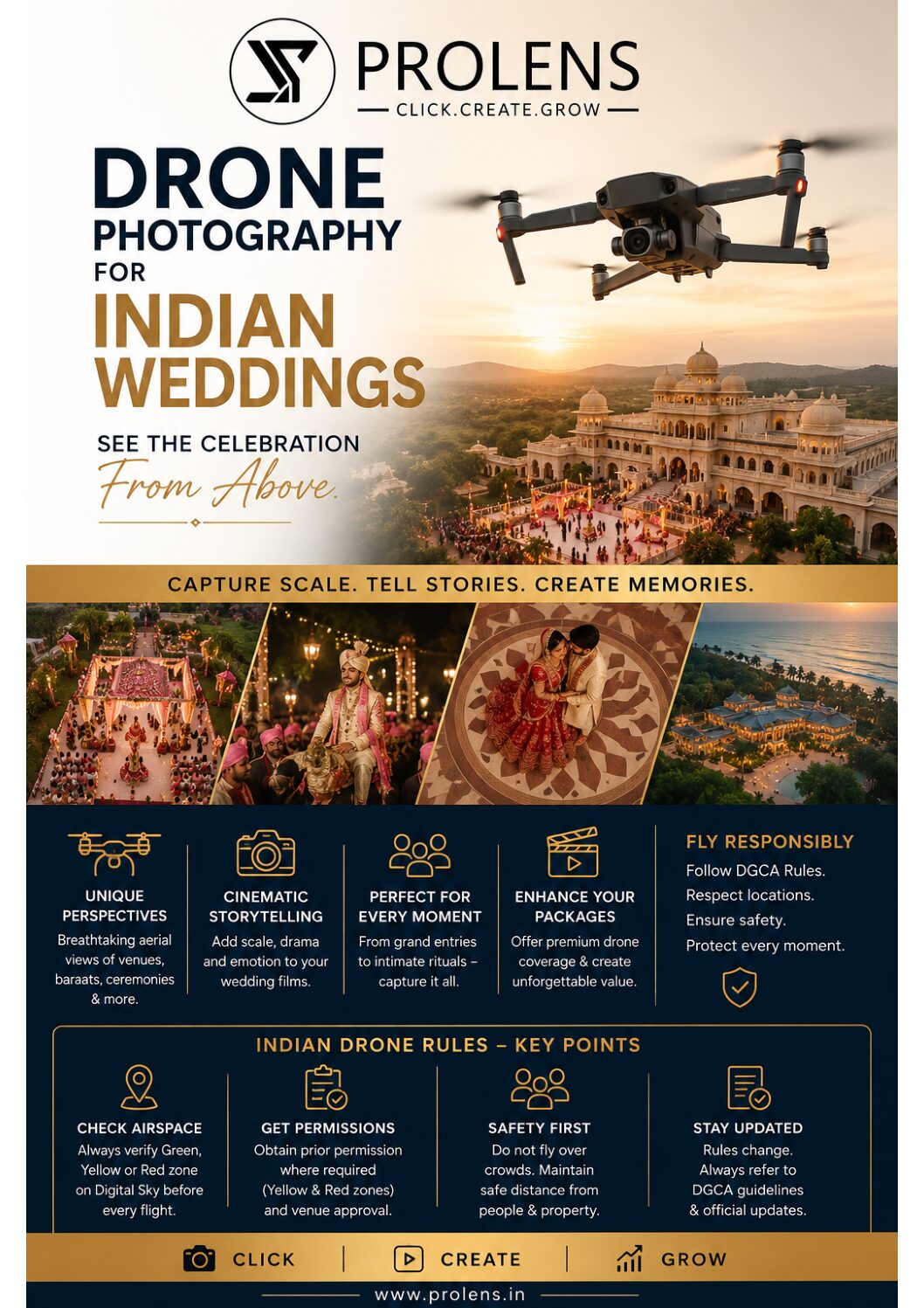
From grand palace weddings in Rajasthan to beach celebrations in Goa and destination weddings across India, drones have transformed the way wedding photographers and cinematographers capture the scale and atmosphere of a celebration.
Aerial photography is no longer simply a cinematic luxury. For many premium Indian wedding productions, drone footage has become an important part of the visual storytelling package.
A drone can reveal the grandeur of a wedding venue, follow a baraat, capture an outdoor ceremony from above or establish the location of a destination wedding in a single powerful frame.
But with this opportunity comes responsibility.
For professional wedding photographers and filmmakers, choosing the right drone, understanding Indian regulations, obtaining necessary permissions and operating safely around guests are essential.
Why Drones Are Becoming Important in Indian Wedding Photography
Indian weddings are visually spectacular and often take place across large venues.
A typical destination wedding may include:
- Palace or heritage venues
- Resorts
- Beaches
- Lawns and gardens
- Multiple wedding functions
- Large guest gatherings
- Baraats
- Outdoor ceremonies
- Stage and reception areas
Traditional cameras capture the emotion and details.
The drone captures the scale.
This combination can create a much more complete wedding story.
Where Drone Photography Adds Value
1. Venue Establishing Shots
One of the most effective uses of a drone is to introduce the wedding venue.
Aerial footage can show:
The location → the property → the décor → the ceremony → the celebration.
This is particularly effective for:
- Palace weddings
- Luxury resorts
- Beach weddings
- Farmhouse weddings
- Heritage properties
- Destination weddings
2. Baraat Coverage
The baraat is one of the most dynamic moments of an Indian wedding.
Aerial footage can communicate:
- The scale of the procession
- The movement of the guests
- The groom’s entrance
- Music and dancing
- Venue surroundings
However, the drone should never be flown recklessly over a moving crowd simply to obtain a dramatic shot.
Safety must take priority over the image.
3. Outdoor Wedding Ceremonies
For large outdoor ceremonies, a drone can provide an elevated perspective of:
- Mandap
- Couple
- Family
- Guests
- Décor
- Venue layout
A carefully composed top-down or high-angle shot can become one of the signature frames of a wedding film.
4. Couple Portraits
Drone photography can also create creative couple portraits.
For example:
- Couple standing in a garden
- Couple surrounded by floral décor
- Couple walking through a palace courtyard
- Couple on a beach
- Couple surrounded by architectural patterns
The key is to use the drone as a creative camera, not simply as an aerial video recorder.
Drone + Wedding Cinematography
The strongest wedding films usually combine different perspectives.
Ground Camera
Captures:
- Emotions
- Expressions
- Details
- Rituals
- Speeches
- Family interactions
Gimbal
Captures:
- Movement
- Entrances
- Couple sequences
- Venue details
Drone
Captures:
- Scale
- Location
- Architecture
- Crowd movement
- Establishing shots
Together, these perspectives can create a more cinematic wedding film.
Choosing a Drone for Wedding Assignments
You don’t necessarily need the largest or most expensive drone.
For wedding professionals, look at:
Camera Quality
Consider:
- Sensor size
- Dynamic range
- RAW still photography
- 4K video capability
- Frame rates
- Low-light performance
- Colour profiles
Stabilisation
A reliable gimbal is essential for smooth professional footage.
Battery Life
A wedding assignment can last many hours.
Plan for:
Drone + Multiple Batteries + Charger + Backup Plan
Obstacle Sensing
Obstacle detection can provide an additional safety layer, but it should never replace an experienced pilot.
The Indian Wedding Drone Rules You Need to Know
This is perhaps the most important section for Indian wedding photographers.
Drone operations in India are regulated under the framework administered by the Directorate General of Civil Aviation (DGCA) and the Ministry of Civil Aviation.
The Drone Rules framework provides for an airspace map dividing drone-operating areas into green, yellow and red zones. Before a flight, the operator must verify the applicable restrictions for the intended location.
The basic principle is simple:
Never assume that a wedding venue is automatically safe or permitted for drone operation.
Check the airspace before every assignment.
Green, Yellow and Red Zones
Green Zone
Drone operations can generally take place without prior permission, subject to the applicable rules and mandatory pre-flight verification.
The Drone Rules define green-zone airspace up to 400 feet/120 metres in the applicable areas, with specific provisions around operational airports.
Yellow Zone
This is restricted airspace.
Prior permission is required before operating in a yellow zone.
Red Zone
Drone operations are highly restricted and require the necessary Central Government permission.
Most important rule:
Check the current airspace status immediately before flying.
The rules provide for the airspace map to be updated, and temporary restrictions can also be imposed.
Don’t Rely on Yesterday’s Airspace Information
A location that was permissible for a previous wedding may not necessarily be permissible for your next assignment.
Before every flight:
Check → Confirm → Fly
The Drone Rules specifically require the remote pilot to verify the Digital Sky platform for applicable notifications or restrictions before commencing an operation.
For professional wedding teams, this should become part of the standard pre-production checklist.
Airport and Sensitive Locations
Extra caution is required when the wedding is being held near:
- Airports
- Military establishments
- Government facilities
- Sensitive installations
- Major infrastructure
- Large public gatherings
This is particularly important for destination weddings in major cities and for luxury properties located close to airports.
If you are unsure, do not fly until the regulatory position has been verified.
Venue Permission Is Also Essential
Even when the airspace permits drone operations, the wedding venue may have its own restrictions.
Before the wedding, coordinate with:
- Wedding planner
- Venue management
- Client
- Security team
- Drone operator
Obtain appropriate venue consent and establish:
- Take-off location
- Landing location
- Flight area
- Safe operating area
- Guest exclusion area
- Emergency landing procedure
A venue’s permission does not replace statutory aviation requirements.
Both need to be considered separately.
Never Fly Recklessly Over Wedding Guests
This is one of the most important safety considerations.
Indian weddings can involve hundreds or even thousands of people.
There may also be:
- Children
- Elderly guests
- Moving vehicles
- Decorative structures
- Electrical cables
- Tents
- Fireworks
- Temporary lighting
- Dense crowds
A drone failure can cause serious injury.
Therefore:
Avoid unnecessary flight over crowds.
Maintain a safe operating area.
Do not fly close to people simply to obtain a dramatic shot.
Never sacrifice safety for social-media content.
Who Should Operate the Drone?
For professional wedding assignments, the drone should ideally be operated by a person who understands:
- Drone controls
- Airspace
- Weather
- Battery management
- Emergency procedures
- Safety protocols
- Applicable DGCA requirements
If the photography team does not have this expertise, partner with a professional drone operator.
This is often safer and more commercially sensible than asking a photographer to operate a drone casually between camera assignments.
A Current Regulatory Point for Drone Buyers
Photographers should be especially careful when purchasing drones in India.
The current DGCA website states that registration of non-Type-Certified (non-TC) UAS is temporarily suspended until further notice.
Therefore, do not purchase a drone based solely on:
- YouTube reviews
- Social-media recommendations
- Overseas specifications
- Advice from another photographer
Before purchasing a drone for professional work, verify its current regulatory and certification status in India.
Drone Categories
The Indian regulatory framework classifies unmanned aircraft according to weight, including:
- Nano: up to 250g
- Micro: above 250g up to 2kg
- Small: above 2kg up to 25kg
- Medium: above 25kg up to 150kg
- Large: above 150kg
The classification forms part of India’s regulatory framework for unmanned aircraft.
Important:
Do not assume that a sub-250g drone is automatically permitted to fly anywhere or in every situation.
Airspace restrictions and other applicable requirements still need to be checked.
Weather Matters at Indian Weddings
Indian wedding locations can present very different flying conditions.
You may encounter:
- Strong coastal winds
- Extreme summer heat
- High humidity
- Dust
- Mountain winds
- Monsoon conditions
- Low visibility
Before taking off, check:
Wind + Weather + Visibility + Battery + Flight Area
If the conditions are unsafe, postpone the flight.
There is always another opportunity to capture a beautiful shot.
There isn’t always another opportunity after an accident.
Battery Management for Wedding Shoots
A professional drone operator should arrive at the venue with:
- Fully charged batteries
- Spare batteries
- Battery charging system
- Spare propellers
- Memory cards
- Backup storage
- Appropriate cables
Do not wait until the wedding begins to discover that the batteries are insufficient for the planned coverage.
Plan the Drone Shots Before the Wedding
Drone photography should be part of the wedding production plan.
Discuss the following with the couple and planner:
Where?
- Venue exterior
- Garden
- Beach
- Palace courtyard
- Ceremony area
When?
- Venue setup
- Baraat
- Couple entry
- Ceremony
- Golden hour
- Sunset
What?
- Establishing shot
- Top-down shot
- Reveal
- Tracking shot
- Wide venue shot
- Couple portrait
Planning creates better footage and reduces unnecessary flying.
Drone Footage Should Tell a Story
Aerial footage should not become a collection of random “drone shots.”
Instead, think of the wedding film as a story.
Opening
Aerial venue reveal
↓
Preparation
Ground-level details
↓
Celebration
Baraat + aerial movement
↓
Ceremony
Emotional close-ups + wide aerial perspective
↓
Couple
Creative aerial portrait
↓
Finale
Wide venue or sunset shot
The drone becomes part of the storytelling language.
Drone Photography as an Additional Wedding Service
For professional photographers, drone coverage can become an additional revenue stream.
For example:
Wedding Photography Package
Candid Photography + Traditional Photography + Drone
Cinematic Package
Wedding Film + Gimbal + Drone
Destination Wedding Package
Photography + Cinematography + Drone + Same-Day Edit
The key is to sell the visual experience, not simply “drone coverage.”
Buy, Rent or Partner?
Not every wedding photographer needs to own a drone.
Buy
Consider buying when you have frequent drone assignments.
Rent
Useful when drone requirements are occasional.
Partner
For complex or high-value weddings, working with a specialist drone pilot can be the most practical option.
A professional operator can bring:
- Flying experience
- Regulatory knowledge
- Safety procedures
- Backup equipment
- Advanced flight skills
The Professional Wedding Drone Checklist
Before every wedding:
Regulatory
☐ Check current airspace status
☐ Verify applicable DGCA requirements
☐ Confirm drone compliance/certification status
☐ Check for temporary restrictions
Venue
☐ Obtain venue approval
☐ Coordinate with wedding planner
☐ Identify take-off and landing areas
☐ Establish safe operating area
Equipment
☐ Drone
☐ Batteries
☐ Charger
☐ Memory cards
☐ Spare propellers
☐ Backup storage
Safety
☐ Check weather
☐ Check wind
☐ Check surroundings
☐ Keep clear of crowds
☐ Maintain visual awareness
☐ Have an emergency landing plan
The Future of Drone Wedding Photography in India
Indian weddings are becoming increasingly cinematic.
Couples are looking for:
- Bigger visual stories
- Destination experiences
- Short-form social content
- Cinematic wedding films
- Unique perspectives
- Same-day content
Drone photography fits naturally into this evolution.
But the future of professional drone wedding photography will not be defined by who owns the most expensive drone.
It will be defined by who can combine:
Creative Vision + Technical Skill + Safety + Regulatory Compliance + Storytelling
Final Thoughts
A drone can transform the way an Indian wedding is remembered.
It can show the grandeur of a palace, the energy of a baraat, the beauty of a destination or the scale of a celebration in a way that no ground camera can completely replicate.
But professional drone photography requires much more than pressing the take-off button.
Know your equipment.
Know your location.
Know the regulations.
Know your responsibilities.
Most importantly:
Never compromise safety for a photograph.
The best wedding drone operator is not the person who flies closest to the action.
It is the professional who captures the right perspective, at the right moment, safely and legally.
See the Wedding Differently.
Capture the Celebration From Above.
Click. Create. Grow.
Regulatory note: Indian drone regulations, airspace restrictions and DGCA procedures can change. The information above is intended as a practical guide, not legal advice. Wedding photographers, cinematographers and drone operators should verify the latest requirements through official DGCA/Digital Sky channels before every commercial flight.Drone Photography poster