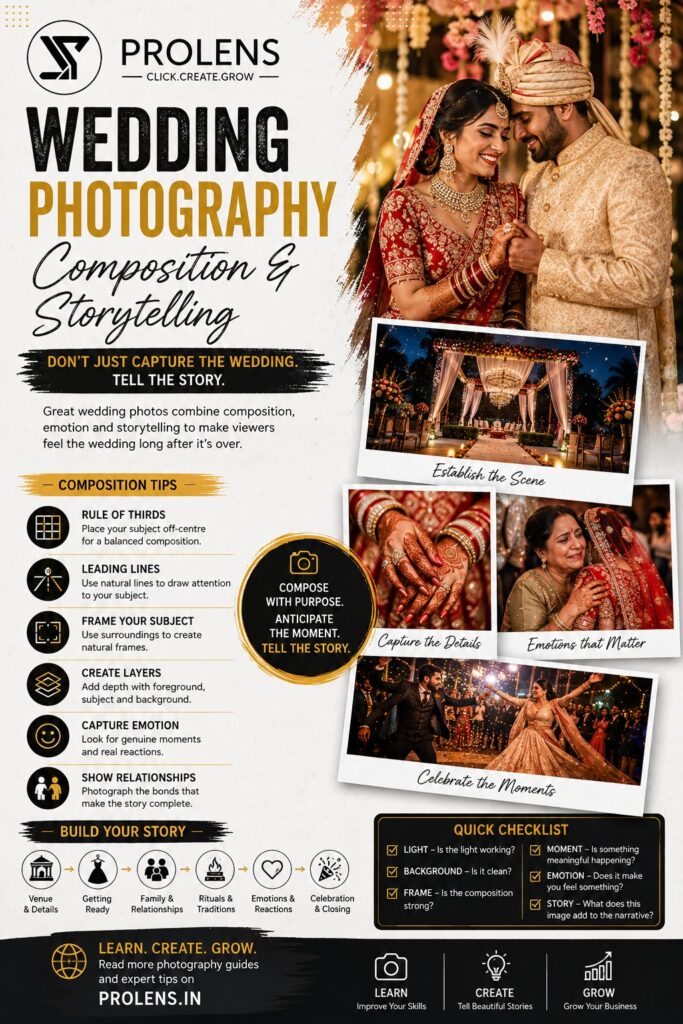
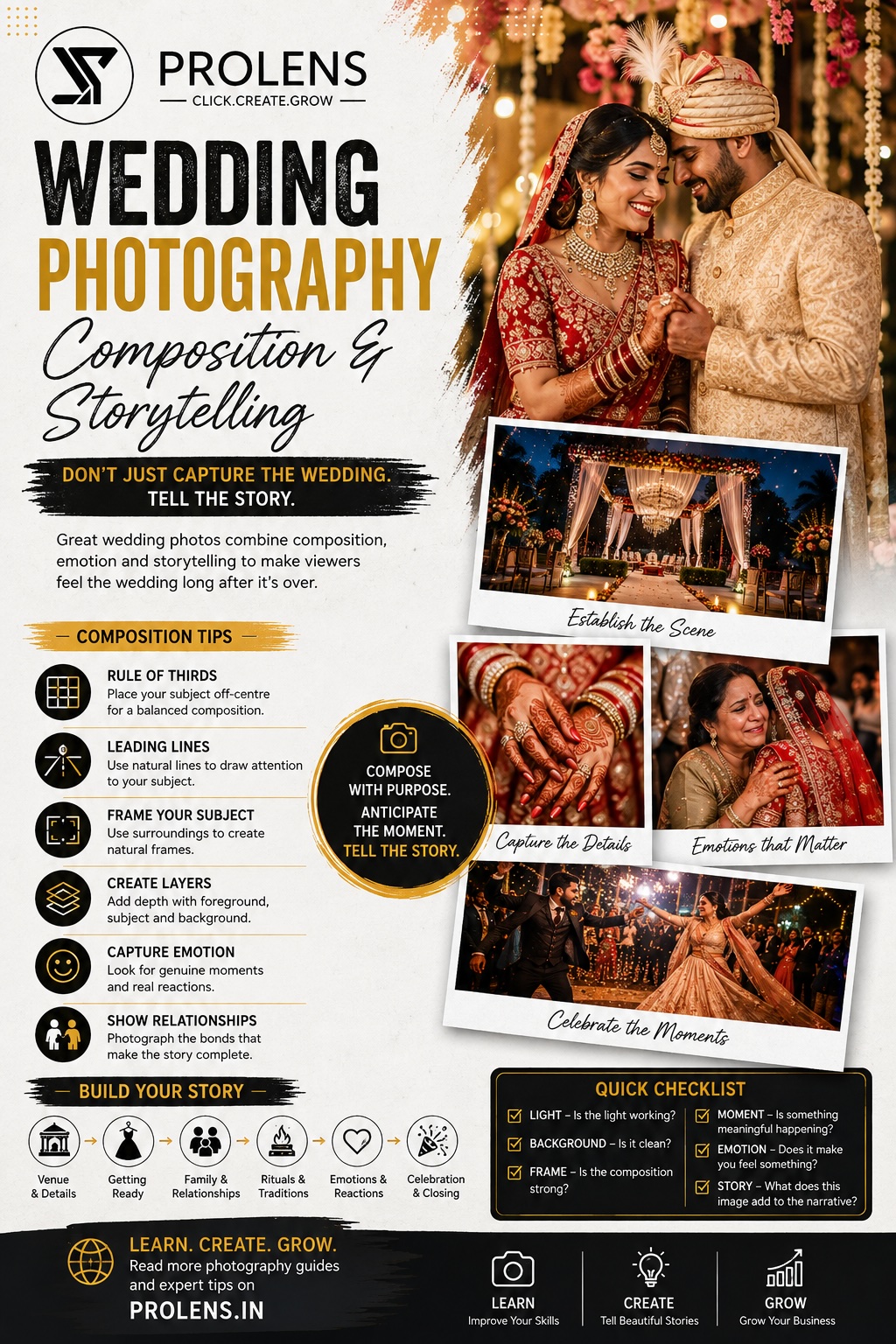
Don’t Just Capture the Wedding. Tell the Story.
Great wedding photography is more than technically perfect images. The strongest photographs combine composition, emotion and storytelling to make viewers feel the wedding long after the celebration is over.
Indian weddings—with their rituals, colours, relationships and spontaneous moments—offer extraordinary opportunities for visual storytelling.
Here is a practical guide from PROLENS – Click. Create. Grow.
1. Think in Stories, Not Individual Photographs
Instead of photographing isolated moments, think about how photographs connect.
A wedding story can flow through:
Venue → Details → Getting Ready → Family → Rituals → Emotions → Celebration → Couple Portraits → Closing Moments
Capture every important scene in three ways:
Wide → Medium → Close
A wide image establishes the environment, a medium image shows the action, and a close-up reveals emotion or detail.
2. Use the Rule of Thirds
Avoid placing every subject directly in the centre.
Positioning the bride, groom or important action along the thirds of the frame can create a more balanced and visually interesting photograph.
But remember: composition rules are guides, not restrictions.
3. Use Leading Lines
Look for architectural and decorative elements that naturally guide the viewer towards your subject.
Use:
- Corridors
- Staircases
- Mandap structures
- Flower arrangements
- Rows of chairs
- Doorways
- Venue architecture
Leading lines can turn an ordinary location into a strong composition.
4. Frame Your Subject
Use objects within the wedding environment as natural frames.
Photograph through:
- Flowers
- Doorways
- Curtains
- Mirrors
- Décor
- Guests
- Architectural arches
Foreground elements add depth and create a feeling of being inside the celebration.
5. Create Layers
Strong wedding photographs often contain more than one point of interest.
Think:
Foreground + Subject + Background
For example, photograph the bride through family members while keeping the decorated mandap visible behind her.
Layering gives photographs depth and helps communicate the scale and atmosphere of an Indian wedding.
6. Capture Emotion Before Perfection
Perfect composition means little if the photograph has no emotion.
Watch for:
- A father’s expression
- A mother’s tears
- Siblings laughing
- Grandparents observing quietly
- Friends celebrating
- The couple exchanging glances
These moments often become more valuable than perfectly posed portraits.
Emotion is the heart of wedding storytelling.
7. Anticipate the Moment
Experienced wedding photographers don’t simply react—they predict.
If the bride is about to enter, don’t only watch her.
Watch:
- The groom
- Her parents
- Siblings
- Grandparents
- Guests
Ask yourself:
“Where is the emotion going to happen next?”
Position yourself before that moment arrives.
8. Photograph Actions and Reactions
For every important ritual, photograph both sides of the story.
During a Varmala, for example:
Action: The couple exchanging garlands
Reaction: Friends cheering
Emotion: Parents watching
Atmosphere: The complete stage and celebration
Together, these images tell a far stronger story than one photograph alone.
9. Use Symmetry
Indian weddings offer excellent opportunities for symmetrical compositions.
Look for:
- Mandaps
- Palace entrances
- Wedding stages
- Floral installations
- Corridors
- Staircases
When symmetry is strong, placing the couple centrally can create a powerful image.
10. Change Your Perspective
Don’t photograph the entire wedding from standing eye level.
Try:
- Low angles
- Elevated positions
- Over-the-shoulder compositions
- Reflections
- Shooting through foreground objects
- Wide environmental views
- Tight close-ups
Changing perspective creates variety and keeps the wedding gallery visually interesting.
11. Include Details That Build the Story
Wedding storytelling isn’t only about people.
Capture:
- Jewellery
- Invitations
- Mehendi
- Flowers
- Rings
- Wedding outfits
- Shoes
- Décor
- Sacred objects
- Family heirlooms
These photographs provide context and work beautifully as supporting images in wedding albums.
12. Show Relationships
A wedding is ultimately about people.
Look beyond the bride and groom and photograph relationships:
Bride + Mother
Groom + Father
Bride + Siblings
Couple + Grandparents
Friends + Couple
A photograph becomes more meaningful when viewers understand the relationship within it.
13. Keep Backgrounds Clean
Before pressing the shutter, quickly scan the frame.
Watch for:
- Distracting people
- Light stands
- Speakers
- Plastic bottles
- Exit signs
- Bright objects
- Objects appearing behind someone’s head
Sometimes moving just one step can transform the composition.
14. Build the Wedding Album Like a Film
Think of the final wedding gallery as a visual movie.
Start with establishing images.
Introduce the people.
Build towards important rituals.
Show reactions and emotions.
Capture the celebration.
Finish with memorable closing photographs.
A good wedding album should allow someone who wasn’t present to understand and feel the wedding.
Quick Composition Checklist
Before pressing the shutter, remember:
LIGHT – Is the light working?
BACKGROUND – Is it clean?
FRAME – Is the composition strong?
MOMENT – Is something meaningful happening?
EMOTION – Does the photograph make you feel something?
STORY – What does this image add to the wedding narrative?
The Golden Rule
Great wedding photographers don’t simply document what happened.
They capture:
Where it happened.
Who was there.
What happened.
How people reacted.
How it felt.
Combine strong composition with genuine human emotion and even a simple moment can become an unforgettable photograph.
Compose with Purpose. Anticipate the Moment. Tell the Story.
PROLENS – Click. Create. Grow.
PROLENS is committed to supporting, educating and empowering photographers across India through practical photography education, workshops and industry engagement.
Explore more photography guides, professional techniques and industry insights at PROLENS.IN.