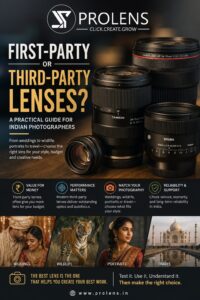
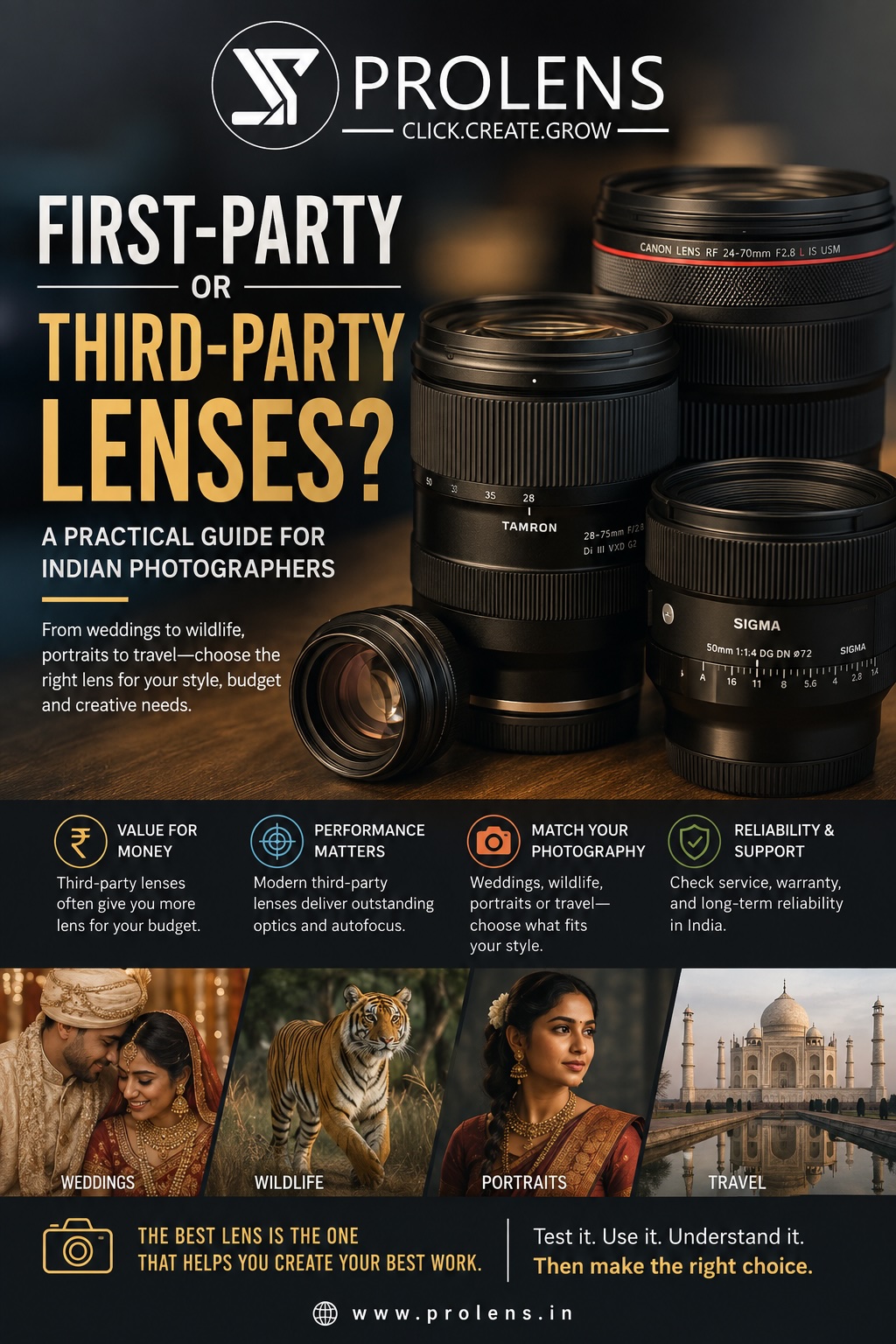
Walk into any major camera store in India and you will find an enormous choice of lenses—from camera manufacturers such as Canon, Nikon, Sony and Fujifilm to specialist brands such as Sigma, Tamron, Viltrox, Samyang and others. But which should you choose? Is the camera manufacturer’s own lens always the better option, or can third-party lenses offer better value and performance?
For photographers investing in an interchangeable-lens camera, choosing the right lens can be just as important as choosing the camera body.
Whether you are a professional wedding photographer in Bengaluru, a wildlife photographer in Karnataka, a filmmaker in Mumbai, a portrait photographer in Delhi or an enthusiast starting your photography journey, the right lens can dramatically influence the way you work.
Starting Your Lens Journey
For photographers purchasing their first mirrorless camera, a kit lens is often the most practical starting point.
Camera manufacturers frequently offer attractive body-and-lens packages that include a standard zoom lens.
Typical kit lenses provide a useful focal-length range for:
- Travel photography
- Family photography
- Events
- Landscapes
- Street photography
- Basic portraits
- Everyday photography
However, a kit lens should be viewed as a starting point rather than the end of your lens journey.
Once you understand your photographic style, you can begin building a lens kit around the subjects you photograph most frequently.
Understanding Your Photography Needs
Before spending money on a lens, ask yourself:
What do I photograph most?
For an Indian wedding photographer, the answer could be very different from that of a wildlife photographer.
Wedding Photography
A professional wedding photographer may consider:
- 24–70mm f/2.8
- 70–200mm f/2.8
- 35mm f/1.4
- 50mm f/1.2 or f/1.4
- 85mm f/1.4 or f/1.8
A 24–70mm is extremely versatile for ceremonies, family groups, portraits and candid moments.
A 70–200mm is valuable for capturing emotional moments from a distance without disturbing the ceremony.
Fast prime lenses become particularly useful for low-light receptions, indoor ceremonies and creative portraits.
Portrait Photography
For portraits, popular choices include:
- 50mm
- 85mm
- 105mm
- 135mm
An 85mm or 105mm lens can provide attractive perspective and subject separation.
Wildlife Photography
India offers extraordinary wildlife opportunities, from Karnataka’s forests to Rajasthan’s tiger reserves and the Northeast.
Wildlife photographers often require longer focal lengths such as:
- 100–400mm
- 180–600mm
- 200–600mm
- 400mm
- 600mm
Here, autofocus performance, image stabilisation, weight and reach can be more important than simply choosing the manufacturer’s most expensive lens.
First-Party Lenses: Why Choose Them?
First-party lenses are lenses produced by the same manufacturer as your camera.
Examples include:
- Canon RF
- Nikon Z
- Sony FE
- Fujifilm XF/GF
One of the biggest advantages is integration.
Camera and lens engineers design their systems to work together, which can provide benefits in areas such as:
- Autofocus
- Image stabilisation
- Electronic communication
- Lens corrections
- Firmware compatibility
- Video performance
For professional photographers, this integration can be extremely valuable.
Image Stabilisation
Image stabilisation is a good example of where camera-and-lens integration can matter.
Some cameras feature IBIS (In-Body Image Stabilisation), while compatible lenses may also feature optical stabilisation.
When both systems work together, photographers can potentially achieve greater stabilisation.
This can be particularly useful in India when shooting:
- Dimly lit wedding venues
- Temples
- Indoor ceremonies
- Cultural performances
- Street photography
- Travel
- Handheld video
However, stabilisation should not be the only factor determining your purchase.
For moving subjects, a fast shutter speed is still essential.
The Case for Third-Party Lenses
The Indian lens market has changed dramatically over the past decade.
Third-party manufacturers such as Sigma, Tamron and Samyang have developed sophisticated lenses capable of delivering professional-level results.
There are two major reasons to consider them.
1. Value for Money
Third-party lenses can sometimes offer comparable optical performance at a lower price than an equivalent first-party lens.
For photographers building a professional kit, this can make a significant difference.
Instead of spending your entire budget on one premium lens, you may be able to build a more versatile kit.
For example, a photographer could consider investing in:
One fast prime + one standard zoom + one telephoto
rather than putting the entire budget into a single first-party lens.
2. More Choice
Third-party manufacturers often introduce lenses that address specific requirements.
You may find:
- Ultra-wide lenses
- Very fast primes
- Compact travel lenses
- Macro lenses
- Affordable telephotos
- Cinema-oriented lenses
- Lightweight zooms
- Specialised lenses
Some of these may not have a direct equivalent from your camera manufacturer.
Has the Third-Party Stigma Disappeared?
For many years, some photographers assumed that a lens had to carry the same brand name as the camera to deliver professional results.
That assumption is increasingly outdated.
Modern third-party lenses can offer:
- Excellent optical quality
- Fast autofocus
- Weather resistance
- High-quality construction
- Advanced coatings
- Excellent sharpness
- Professional video performance
The important question is no longer simply:
“Is it an original manufacturer lens?”
Instead ask:
“Does this particular lens meet my professional requirements?”
Sigma, Tamron and the Indian Professional Market
Brands such as Sigma and Tamron have become increasingly relevant to Indian photographers because they offer alternatives across several popular camera systems.
For wedding professionals, in particular, the combination of performance, aperture, focal length and price can make third-party lenses attractive.
A photographer shooting 30–50 weddings a year needs to consider not just image quality, but also:
- Reliability
- Autofocus consistency
- Service support
- Availability of spare parts
- Weather sealing
- Weight
- Ergonomics
- Long-term durability
The cheapest lens isn’t necessarily the best investment.
Think About the Complete Cost
When purchasing equipment in India, don’t look only at the sticker price.
Consider the total ownership cost.
This includes:
- GST-inclusive purchase price
- Warranty
- Extended warranty
- Service availability
- Firmware updates
- Accessories
- Resale value
- Rental availability
- Repair costs
For professionals, local service support can be particularly important.
A lens may be excellent on paper, but if servicing it becomes difficult, that can become a problem when it is part of your working kit.
Buying Used Lenses in India
The third-party versus first-party discussion becomes even more interesting when you consider the used market.
Professional photographers frequently upgrade their equipment, creating opportunities to purchase high-quality lenses second-hand.
Before buying a used lens, check:
- Autofocus accuracy
- Optical condition
- Front and rear elements
- Fungus
- Haze
- Internal dust
- Zoom and focus rings
- Stabilisation
- Mount condition
- Firmware
- Physical damage
- Original invoice, if available
For professionals, buying from a reputable dealer with a return policy can provide additional security.
Don’t Buy a Lens Because Someone Else Uses It
One of the biggest mistakes photographers make is purchasing equipment based entirely on what another photographer uses.
A famous wedding photographer may use a 50mm f/1.2.
That doesn’t mean you need one.
Another photographer may swear by a 24–70mm.
That doesn’t automatically make it the right lens for your workflow.
Your lens selection should be based on:
Your subject + your shooting style + your budget + your working conditions.
Wedding Photography: A Practical Example
Imagine a photographer covering a traditional South Indian wedding.
The photographer may need to move between:
- Bride preparation
- Groom preparation
- Muhurtham
- Family portraits
- Candid moments
- Reception
- Stage portraits
- Dance performances
A practical two-lens setup could be:
24–70mm f/2.8 + 70–200mm f/2.8
This provides an enormous range without constantly changing lenses.
A photographer who prefers primes could instead build around:
35mm + 50mm + 85mm
The choice depends entirely on the photographer’s style.
For Indian Filmmakers
Lens selection becomes even more important for cinematographers.
Video professionals need to consider:
- Focus breathing
- Manual focus feel
- Focus throw
- Aperture consistency
- Image stabilisation
- Autofocus noise
- Gimbal compatibility
- Lens size and weight
- Matching colour rendition between lenses
For a wedding filmmaker using a gimbal, a lightweight and compact lens may actually be more useful than a heavier premium lens.
For a cinematic production, a matched set of lenses may be preferable.
Prime or Zoom?
This remains one of the classic photography debates.
Prime Lenses
Advantages:
- Wide apertures
- Often excellent optical quality
- Strong subject separation
- Compact options available
- Encourages creative composition
Disadvantages:
- Limited focal length
- More lens changes
- Less convenient during fast-paced events
Zoom Lenses
Advantages:
- Versatility
- Faster framing
- Fewer lens changes
- Excellent for weddings and events
- Useful for travel
Disadvantages:
- Some models are larger and heavier
- Often more expensive at the premium end
For wedding professionals, zoom lenses can be extremely practical.
For portrait specialists, primes may offer a more distinctive look.
The Best Lens Is the One You Actually Use
Photography is not about owning the largest collection of lenses.
A photographer who understands one 35mm lens exceptionally well can create better photographs than someone carrying ten lenses without understanding how they see.
Before buying, consider renting the lens for a weekend or an assignment.
Shoot with it.
Check:
- Autofocus
- Sharpness
- Bokeh
- Distortion
- Flare
- Handling
- Weight
- Low-light performance
Then decide.
Try Before You Buy
If possible, visit a reputable camera retailer or rental service where you can physically handle the lens.
Mount it on your camera.
Take photographs.
Test autofocus.
Check how it feels in your hand.
If you are a wedding photographer, test it with the kind of movements you encounter during an actual event.
If you are a filmmaker, put it on your gimbal.
The specifications tell you what the lens can do.
Using the lens tells you whether it is right for you.
Final Thoughts
The choice between a first-party and third-party lens is no longer as simple as saying that one is always better than the other.
First-party lenses can offer excellent integration, advanced autofocus and system-specific features.
Third-party lenses can provide exceptional optical performance, innovative designs and potentially better value for money.
For Indian photographers, the decision should ultimately come down to:
Performance + Reliability + Service + Budget + Shooting Style
Don’t buy a lens simply because it is expensive.
Don’t reject a lens simply because it doesn’t carry the same logo as your camera.
Do your research, rent or test the lens where possible, speak to experienced photographers and consider how it fits into your actual workflow.
Because the best lens isn’t necessarily the most expensive one.
It’s the lens that helps you create the photographs you want—and keeps delivering when the assignment really matters.