 Why the most colourful, chaotic, and emotionally charged celebrations in the world will make you a far better photographer — and a far better person
Indian weddings are not a single event. They are a multi-day universe — a Haldi ceremony drenched in turmeric and laughter, a Mehendi evening buzzing with music and intricate artistry, a Sangeet night that rivals a Bollywood production, and a Baraat procession that brings an entire street to life before the main ceremony has even begun.
And yet, ask many photographers across India whether they shoot weddings, and you’ll hear the same hesitation. “Too stressful.” “Too much responsibility.” “I did one once — never again.”
At Prolens, we believe that’s a missed opportunity of the highest order. Whether you’re an enthusiast photographer in Indore, a portrait photographer in Kochi, or a working professional in Mumbai, shooting an Indian wedding — even just one or two — will transform your photography in ways that no workshop, YouTube tutorial, or camera club meeting ever could.
Here’s why.
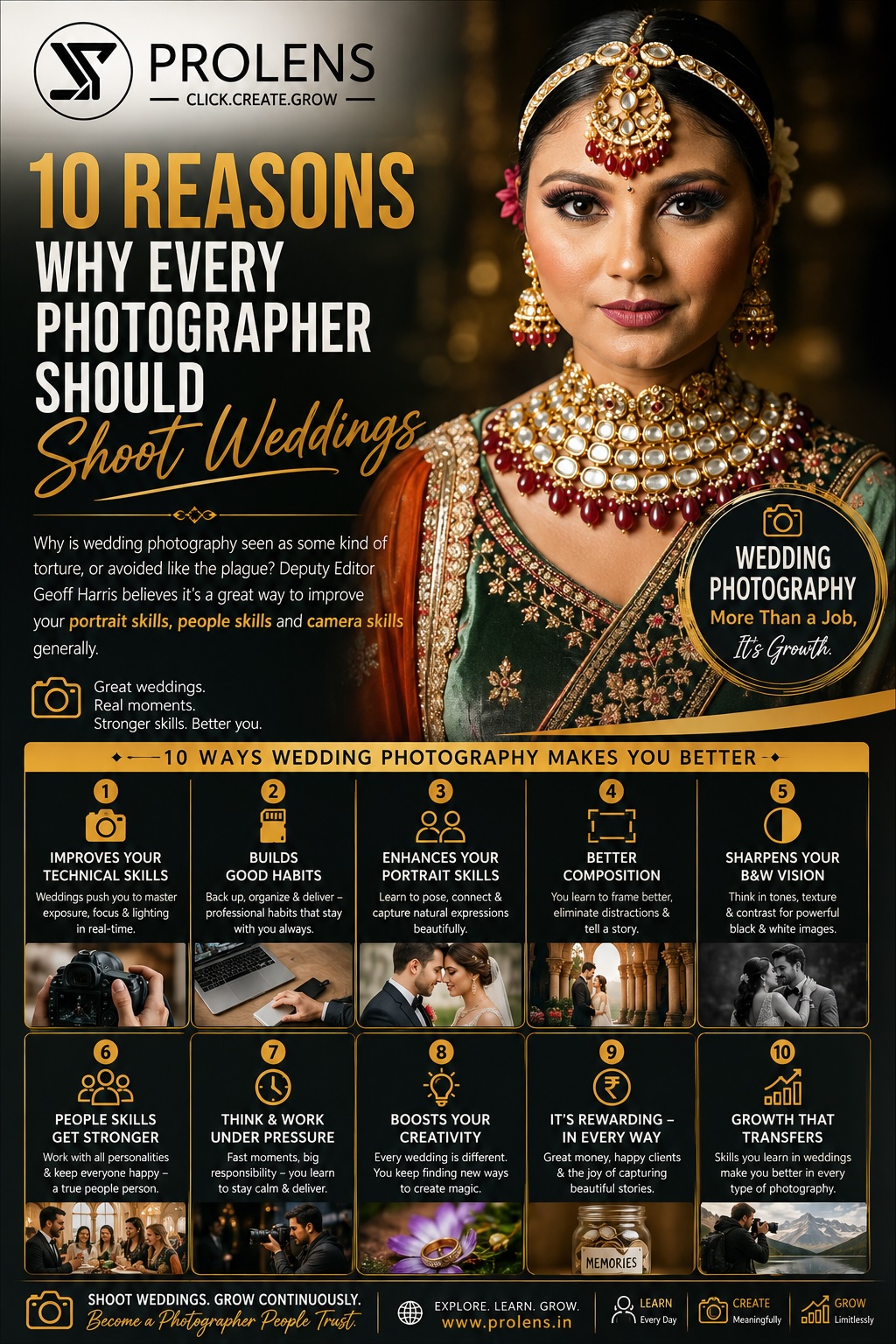
1. There Is No Better Technical Bootcamp
Indian weddings will stress-test every technical skill you have, and then some.
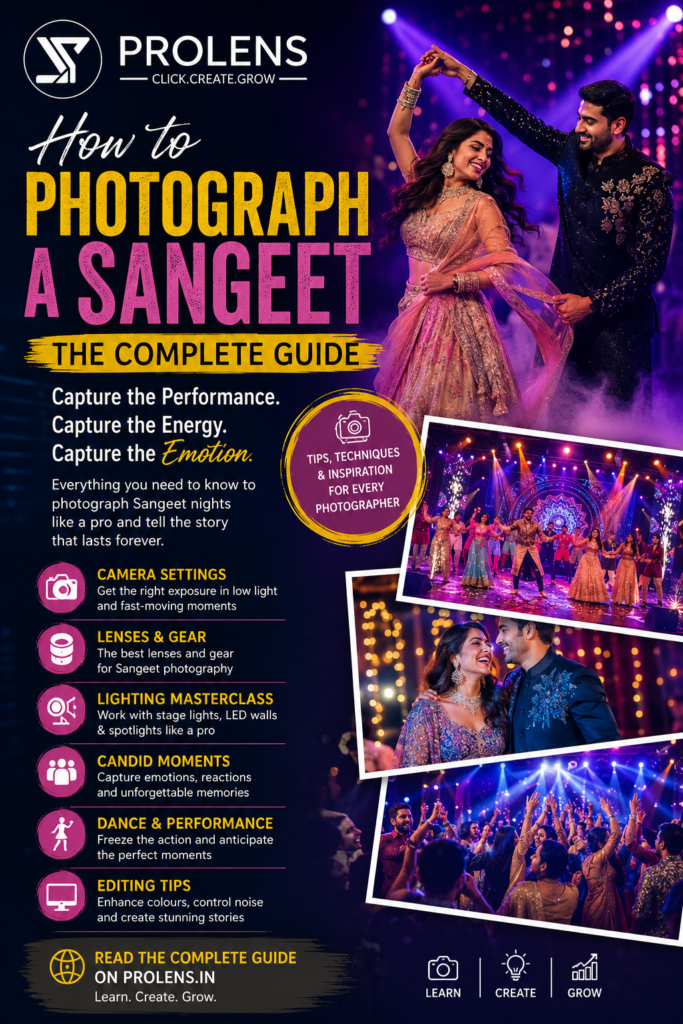
The Haldi happens in harsh afternoon sunlight. The Pheras take place under a canopy with mixed tungsten and LED lighting. The reception runs into the night with coloured stage lights that will make your auto white balance weep. And through all of it, you cannot ask the pandit to repeat the Saat Phere because your exposure was off.
You learn the exposure triangle not in theory but under fire. You learn to switch between shooting modes in seconds. You learn to read a histogram not occasionally — but obsessively. And when you encounter a mandap draped in marigolds and red fabric with a backlit couple at the centre, you learn to nail that shot fast, because it won’t wait.
No classroom teaches this. Weddings do.
2. You Develop an Instinct for Colour — India’s Greatest Visual Gift
If there is one thing that separates Indian wedding photography from almost any other genre in the world, it is colour.
A Punjabi bride in a rich red lehenga against a field of yellow marigolds. A South Indian bride in a Kanjivaram silk saree, draped in gold, against a backdrop of banana leaves and banana flowers. A Rajasthani celebration where every guest seems dressed in a different jewel tone.
Shooting these scenes trains your eye in ways that landscape or street photography simply cannot replicate. You learn how complementary colours interact in-frame. You learn when to expose for the dress and when to expose for the face. You learn that colour grading is not an afterthought — it is half the story of an Indian wedding image.
These skills sharpen your eye permanently, and carry into every other kind of photography you do.
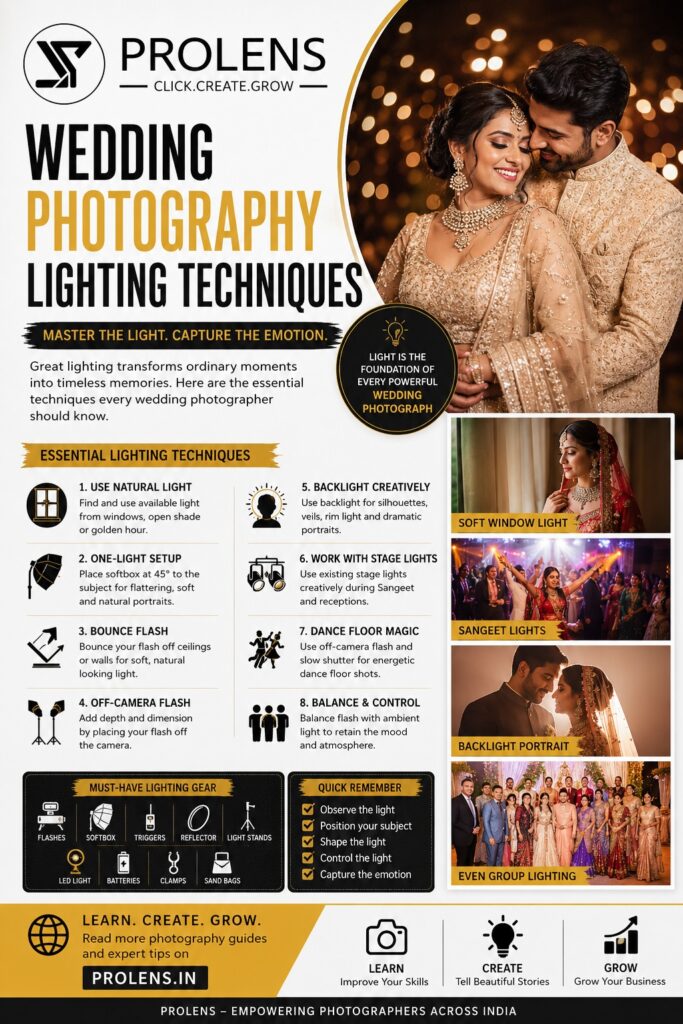
3. You Master Difficult Light — All of It, in a Single Day
A typical Indian wedding day is a masterclass in challenging light, served in rapid succession.
Morning rituals often happen indoors with low, warm, and inconsistent light. Outdoor ceremonies battle overhead sun, deep shadows, and reflective fabrics that blow out highlights in seconds. Evening receptions throw coloured LED washes, uplighting, and candlelight at you simultaneously, all while guests are moving, dancing, and crowding the frame.
Many photographers build their entire career learning to handle two or three of these conditions. An Indian wedding gives you all of them in one booking.
You will learn to use a flashgun with confidence — not just as a crutch, but as a creative tool. You will learn when to bounce, when to diffuse, and when to put it away entirely and work with the beautiful chaos of available light.
4. Your Portrait Skills Will Reach a New Level
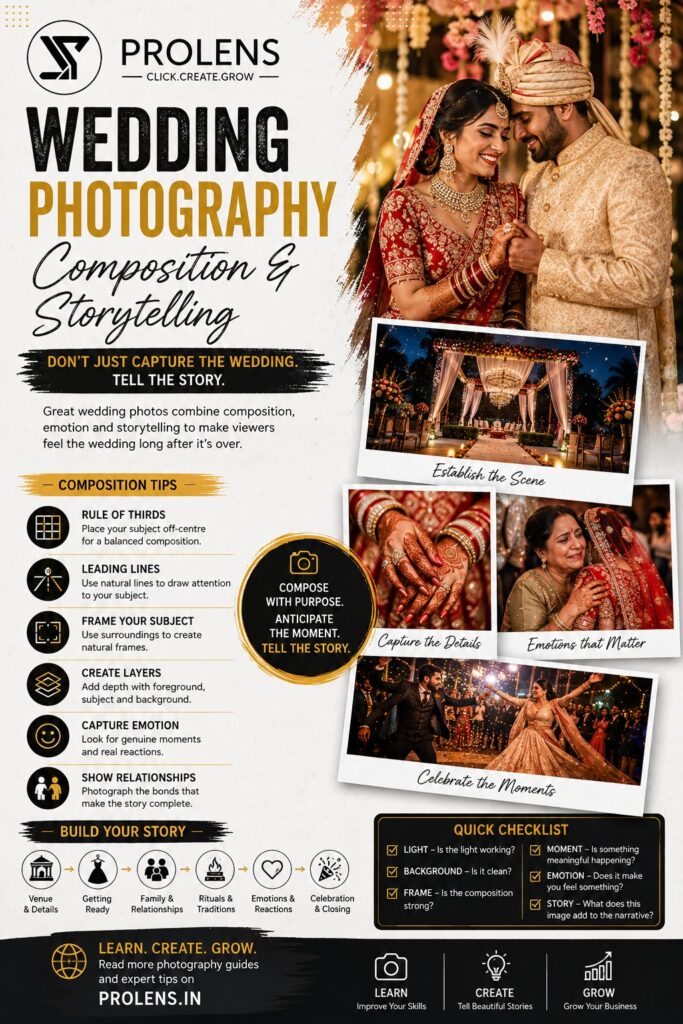
Indian weddings are portrait photography on a scale most photographers never experience.
You will photograph the bride alone, then with her mother, then with her bridesmaids, then with both families, then with the groom, then with his family, then with the entire baraat. At each point, you are managing posing, expressions, backgrounds, light, and emotion — simultaneously.
You learn how to make a nervous groom relax in front of the lens. You learn how to capture a mother’s expression at the Vidaai without staging it. You learn that sometimes the most powerful portrait is not of the subject looking at the camera — but of them looking at someone they love.
These instincts make you a better portrait photographer everywhere. In the studio. On the street. At any Prolens workshop.
5. Composition Becomes Second Nature
Indian weddings are visually rich to the point of overwhelming — and that is exactly why they are such powerful composition training.
When your background contains a decorated mandap, fifty seated guests, string lights, flower arrangements, and a catering tent, you learn very quickly how to isolate your subject. You learn to find clean lines within chaos. You learn to use depth of field, angle, and positioning to tell a clear story even in a cluttered environment.
You also shoot more frames in a single Indian wedding than most photographers shoot in a month of weekends. Every frame is a composition decision. That volume of practice, over even two or three weddings, reshapes how you see a frame in every context.
6. You Learn to Shoot Candid Moments — India’s Most Emotional Photography
The best Indian wedding photographs are rarely posed. They are the grandmother wiping a tear during the Vidaai. The groom’s youngest nephew, overwhelmed and asleep across three chairs at the reception. The bride stealing a glance at her husband during the first dance.
Shooting these moments trains your anticipation. You learn to read a room. You learn where to position yourself so you are invisible but present. You learn to pre-focus, to wait, to be patient — and then to move decisively the moment the moment arrives.
This is the core skill of documentary, street, and editorial photography. Indian weddings teach it at an intensity that is hard to replicate anywhere else.
7. You Build People Skills That Last a Lifetime
Photographing an Indian wedding means managing people — a lot of people.
Getting three hundred guests into a group shot after dinner requires a particular combination of warmth, humour, authority, and patience. Coordinating families for the formal portraits while the DJ is calling everyone back to the dance floor requires diplomacy. Managing relatives who all want to take their own phone photographs while you are trying to get your shot requires grace under pressure.
You will also learn to work respectfully with priests, pandits, maulvis, and officiants — understanding that they are running the ceremony, not you. Reading their cues, anticipating the ritual moments, and staying completely unobtrusive while remaining completely alert is an art form.
All of this makes you more confident and more capable in every social and professional context — photography and otherwise.
8. Editing Large Volumes Sharpens Your Eye Dramatically
A multi-day Indian wedding can produce anywhere from 1,500 to 4,000 raw images. Culling and editing that volume — on a deadline, with a client waiting — is an intensive education in picture editing.
You develop speed. You develop consistency. You develop a clear visual language for what a great image actually is versus what merely seems acceptable at first glance. You learn colour grading at scale, which is particularly important for Indian weddings where skin tone accuracy and fabric colour fidelity matter enormously to the families.
The editing discipline you build on weddings transforms how you approach post-processing on every other project.
9. It Builds Real Confidence in Your Work
India’s photography community, like creative communities everywhere, can be prone to self-doubt. Social media comparisons, camera club critiques, and the constant noise of online opinion can make it easy to feel like your work is never quite good enough.
Delivering a wedding gallery that makes a family cry with happiness — and being paid fairly for it — is one of the most direct confidence-builders available to any photographer.
You are not just taking pictures. You are preserving the most important day in a family’s life. The aunts will show these images to their neighbours. The grandparents will print them and hang them on walls. The couple’s children, twenty years from now, may look through these photographs to understand who their parents were on that day.
That is real work. It earns real respect — including the kind you extend to yourself.
10. Indian Weddings Are an Extraordinary Privilege to Document
Let us end with this.
No wedding culture in the world is quite like India’s. The scale, the ceremony, the multi-generational participation, the layering of ritual and colour and music and food and emotion — it is, by any measure, one of the most photographically rich environments on earth.
To be given access to that as a photographer is a privilege. You are not just a vendor. You are a storyteller, trusted with the visual memory of an entire family’s most significant celebration.
Yes, it is demanding work. Your feet will ache. Your back will protest. Your shutter finger may genuinely hurt by the end of day two. But the images you create will outlast all of us — and in a world drowning in forgettable content, that is something worth every moment of effort.
At Prolens, we run hands-on wedding photography workshops across 58+ cities in India — from Mumbai and Delhi to Coimbatore, Nagpur, and beyond. If you want to develop the skills to shoot Indian weddings with confidence, check out our upcoming workshops at www.prolens.in.