Indian weddings are a photographer’s dream—and one of the most demanding assignments to photograph well.
From the vibrant Haldi and Mehendi to the energy of the Baraat, the emotion of the Pheras and the deeply personal Vidaai, an Indian wedding offers an extraordinary combination of colour, tradition, fashion, movement, relationships and emotion.
But great wedding photography isn’t simply about taking beautiful pictures. It is about understanding the rituals, anticipating important moments and creating a visual story that families will treasure for generations.
Here is the Prolens Guide to Indian Wedding Photography.
1. Preparation: Know the Wedding Before You Shoot It
No two Indian weddings are exactly alike. Traditions and ceremonies vary significantly across regions, religions, communities and individual families.
Before the wedding, speak with the couple and understand:
- The complete schedule and sequence of ceremonies
- Important rituals and traditions
- Key family members
- Photography restrictions
- Planned performances or surprises
- Couple portrait timings
- Important photographs expected by the family
Whenever possible, scout the venue beforehand. Identify good portrait locations, available natural light, ceremony positions and potential lighting challenges.
The better prepared you are, the more freedom you have to concentrate on creativity and emotion.
2. Build a Reliable Wedding Photography Kit
Indian weddings are long, fast-moving and unpredictable. Your equipment needs to be versatile and dependable.
A practical professional kit could include:
- Two camera bodies
- 24–70mm standard zoom
- 70–200mm telephoto
- 35mm or 50mm prime
- 85mm portrait lens
- Flash and off-camera lighting
- Multiple memory cards
- Spare batteries
- Backup storage
A second camera body is particularly important. Weddings contain moments that cannot be recreated, so equipment redundancy and regular backups should be part of your professional workflow.
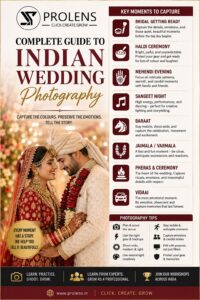
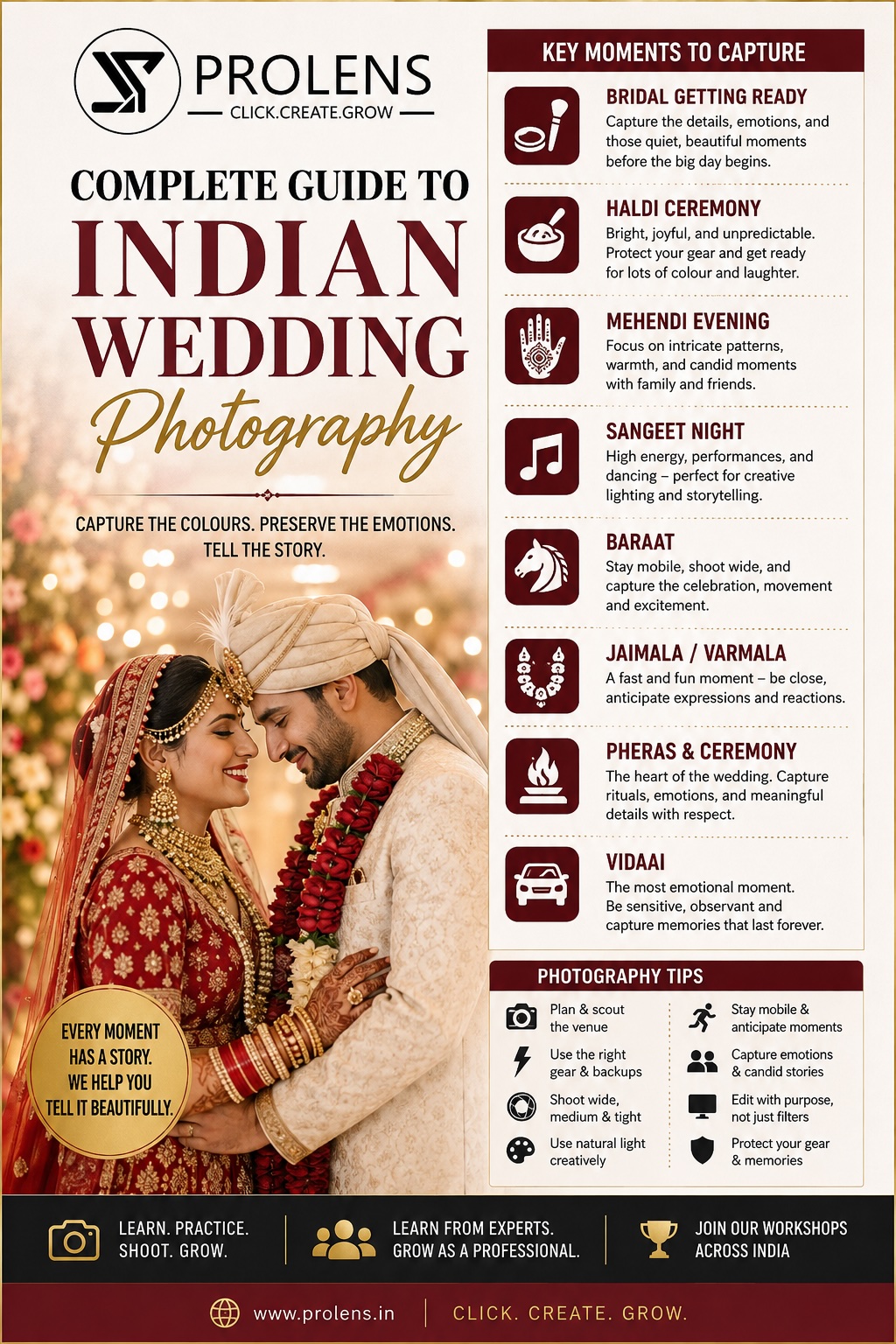
Key Moments Across an Indian Wedding
3. Bridal Getting Ready
The bridal preparation is one of the most intimate parts of the wedding.
Photograph the jewellery, bridal outfit, footwear, Mehendi and other details before they are worn. Then look beyond the obvious photographs.
Capture the mother helping with jewellery, friends assisting the bride, a grandmother’s expression or the bride’s quiet moment before the celebrations begin.
Combine wide photographs, portraits and close-up details to build the story.
4. Haldi Ceremony
Haldi is bright, joyful and unpredictable—making it fantastic for candid photography.
Look for:
- Turmeric being applied
- Flying Haldi
- Laughter and reactions
- Family interactions
- Close-up details
- Wide photographs of the celebration
Protect your camera and lenses because turmeric can be difficult to clean.
Bright yellow Haldi combined with strong daylight can also create challenging exposures, so watch the highlights carefully.
5. Mehendi Evening
Mehendi offers a wonderful combination of detail photography and candid storytelling.
Capture the Mehendi artist working, intricate patterns on the bride’s hands, jewellery, décor and reactions from friends and family.
A macro lens or a lens with good close-focus capability can be particularly useful.
Soft directional light can beautifully reveal the texture and detail of Mehendi designs.
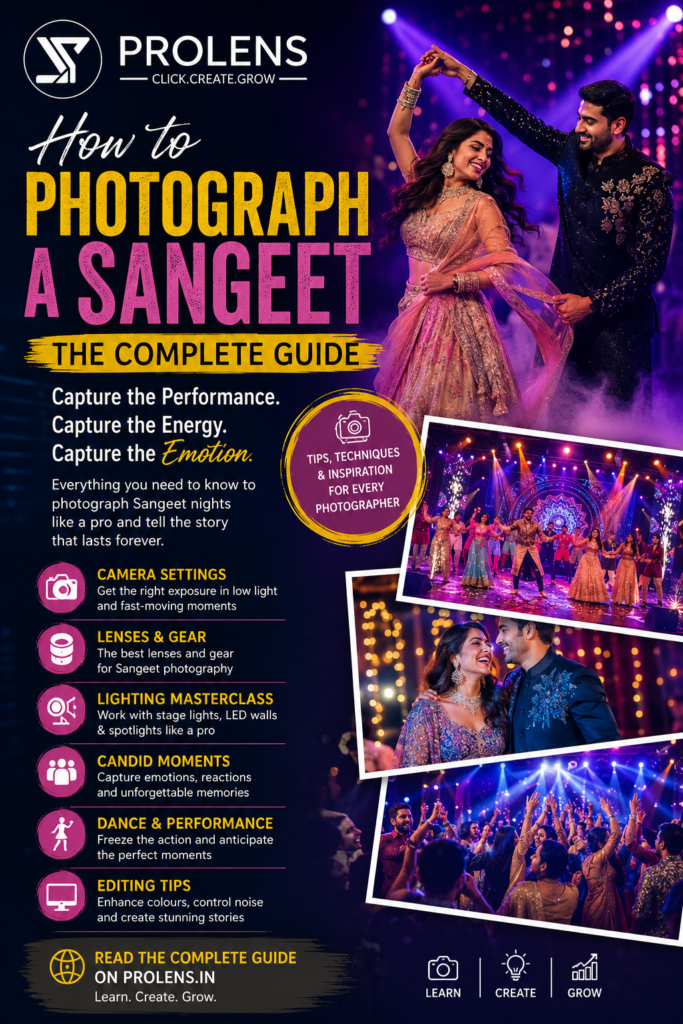
6. Sangeet Night
Sangeet is about energy, performance, movement and colour.
Stage lighting can include coloured LEDs, spotlights and constantly changing light. Rather than eliminating all of this colour, use it creatively to communicate the atmosphere.
Photograph:
- Dance performances
- Family reactions
- Couple interactions
- Musicians and performers
- Wide stage photographs
- Candid moments away from the stage
Off-camera flash can be particularly effective, illuminating the subject while retaining the colourful ambient background.
7. Baraat
The Baraat requires photographers to stay mobile.
Move with the procession and capture more than just the groom.
Look for the Dhol players, relatives dancing, children running alongside, friends celebrating and spontaneous expressions throughout the procession.
Use wider focal lengths when you want viewers to feel part of the celebration and longer lenses when you want to isolate expressions.
If the Baraat coincides with sunset, use the warm golden light before it disappears.
8. Jaimala / Varmala
The exchange of garlands is usually fast, colourful and full of reactions.
Position yourself carefully without obstructing guests or the videography team.
Capture:
- The couple approaching each other
- Garlands being raised
- The actual exchange
- Playful interactions
- Couple’s expressions
- Reactions from family and friends
Keep shooting immediately after the exchange—the spontaneous reactions can sometimes produce stronger photographs than the ritual itself.
9. Pheras & Wedding Ceremony
For many Hindu weddings, the ceremony around the sacred fire is the emotional and ritual heart of the wedding.
Speak with the Pandit beforehand and understand the sequence of events and any restrictions on flash photography.
Important photographs may include:
- Mandap
- Sacred fire
- Pheras
- Saat Phere
- Sindoor
- Mangalsutra
- Hands performing rituals
- Couple’s expressions
- Parents and family reactions
Think in three levels:
Wide: Establish the ceremony and environment.
Medium: Show relationships and interactions.
Tight: Capture expressions, hands and meaningful details.
Together, these images create a much stronger visual narrative.
10. Don’t Forget the Family
One of the biggest mistakes a wedding photographer can make is concentrating exclusively on the bride and groom.
Parents, grandparents, siblings and close friends are essential parts of the story.
During important rituals, watch the people surrounding the couple.
A mother’s expression, a father’s reaction or a grandparent quietly observing the ceremony can become one of the most treasured photographs from the entire wedding.
11. Master the Art of Candid Photography
Good candid photography isn’t simply photographing people when they aren’t looking at the camera.
It requires observation and anticipation.
Watch for conversations, laughter, emotional reactions, children playing, relatives meeting and quiet interactions between family members.
Learn to recognise when something is about to happen—and position yourself before it does.
The strongest candid photographs often last only a fraction of a second.
12. Couple Portraits
The couple portrait session is where the photographer has greater creative control.
Scout three or four locations beforehand rather than spending valuable time searching while the couple waits.
Look for:
- Golden-hour light
- Interesting architecture
- Clean backgrounds
- Window light
- Reflections
- Backlighting
- Foreground elements
Give the couple enough direction to make them comfortable without making every photograph feel posed.
Encourage interaction, conversation and movement.
Very often, the best portrait happens between the poses.
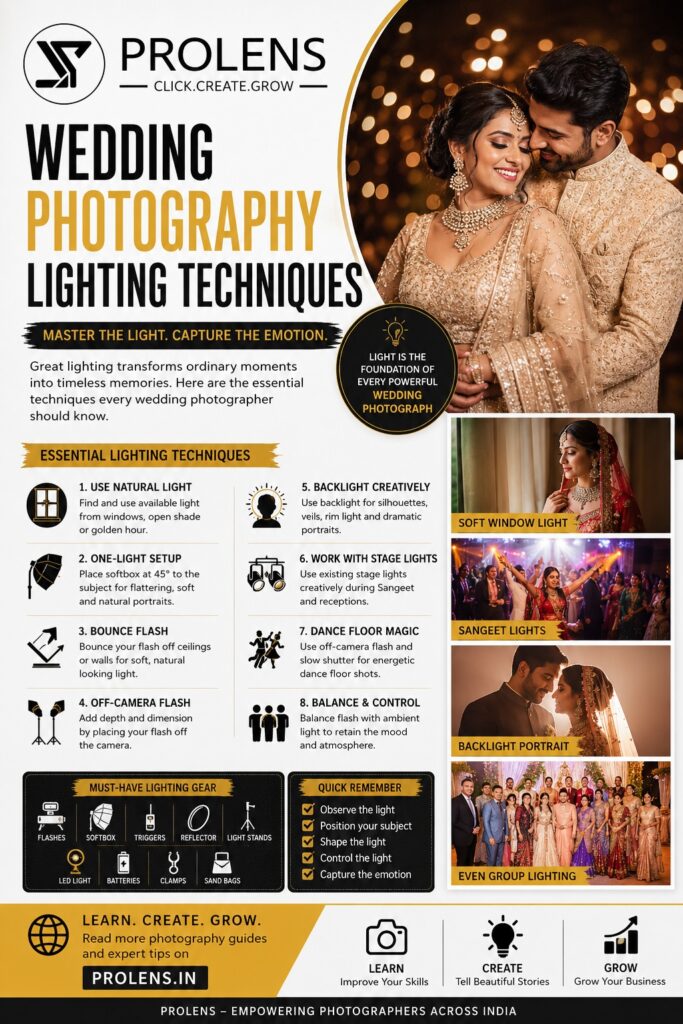
13. Use Light Creatively
Indian weddings can take photographers from bright afternoon sunlight to dimly lit ceremonies and colourful Sangeet stages within a few hours.
Learn to work confidently with:
Natural Light
Windows, open shade, backlighting and golden hour.
Bounce Flash
Useful for indoor ceremonies and receptions where suitable walls or ceilings are available.
Off-Camera Flash
Excellent for dramatic couple portraits, Sangeet and reception photography.
Continuous LED Lighting
Useful for details, portraits and certain low-light situations.
The goal is not always to create more light.
It is to understand the light already available and decide when additional lighting will improve the photograph.
14. Vidaai: Photograph With Sensitivity
Vidaai is often the most emotional part of the wedding.
This isn’t the moment to direct or pose people.
Work quietly and observe.
Capture the bride with her parents, siblings and grandparents, the groom supporting her and the family’s reactions as she leaves.
Whenever possible, maintain enough distance to allow the family to experience the moment naturally.
Sensitivity is more important than getting physically closer.
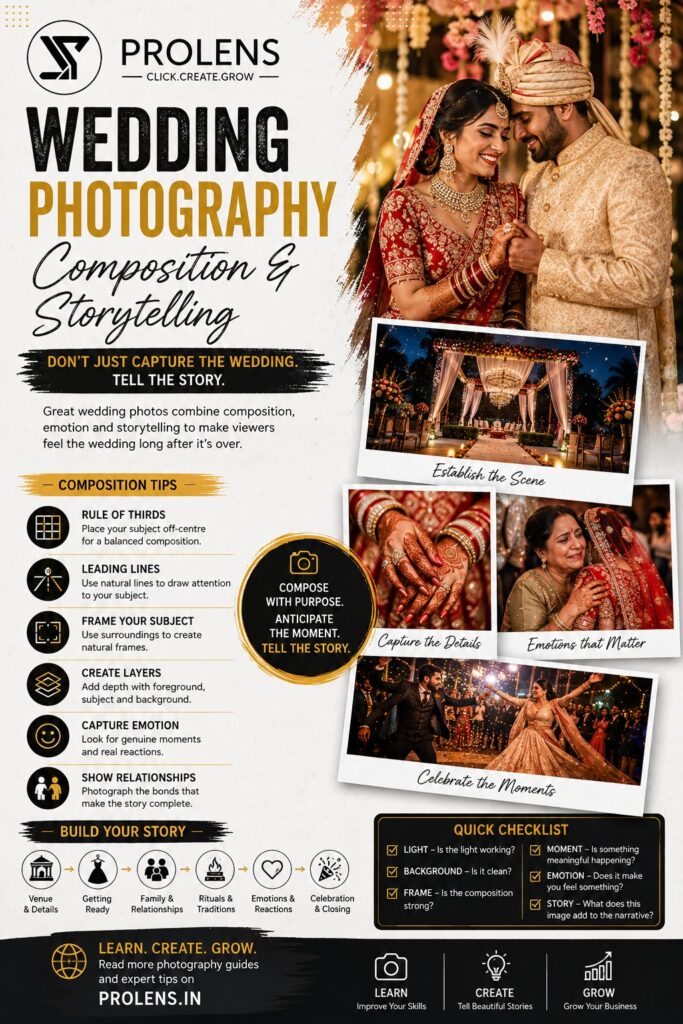
15. Think Like a Storyteller
A wedding album should contain more than a collection of spectacular portraits.
Think about the complete narrative.
Capture:
The Scene — venue, décor and atmosphere.
The Details — jewellery, outfits, flowers and rituals.
The People — bride, groom, family and friends.
The Moments — laughter, tears, celebrations and surprises.
The Portraits — carefully created images of the couple.
The Transitions — the smaller moments connecting one ceremony to another.
When these elements come together, someone who wasn’t at the wedding should still be able to understand how the celebration looked and felt.
16. Edit With Purpose
Indian weddings contain enormous amounts of colour, so post-production needs restraint.
Pay attention to:
- Natural skin tones
- White balance
- Highlight and shadow detail
- Colour consistency
- Cropping and composition
- Noise reduction
- Distracting elements
Avoid excessive saturation and over-processing.
Your editing style should enhance the atmosphere while keeping people and traditions looking authentic.
The Real Skill Behind Great Wedding Photography
Cameras can be purchased.
Lighting techniques can be learned.
Editing software can be mastered.
But one skill separates photographers who simply record weddings from photographers who create memorable stories:
Anticipation.
Learn to read the room.
Notice the mother watching her daughter getting ready.
Watch the father’s expression during the ceremony.
Observe the groom as the bride enters.
Recognise when laughter is about to erupt during the Baraat.
And be ready before the moment happens.
That ability develops through practice, observation, experience and honest review of your own photographs.
Final Thought
Indian weddings offer photographers almost everything imaginable—colour, light, fashion, tradition, spectacle, intimacy, celebration and emotion.
Your responsibility is not simply to create thousands of photographs.
It is to identify the moments that will matter years later.
The flowers will disappear.
The Mandap will be dismantled.
The music will stop.
But the photographs remain.
Don’t merely photograph the wedding. Tell its story.
Learn. Practise. Shoot. Grow.
At PROLENS, we believe photographers grow through practical learning, experimentation and real-world experience.
Our photography workshops and educational initiatives are designed to help photographers strengthen their technical skills, develop their creativity and grow professionally.
PROLENS — Click. Create. Grow.