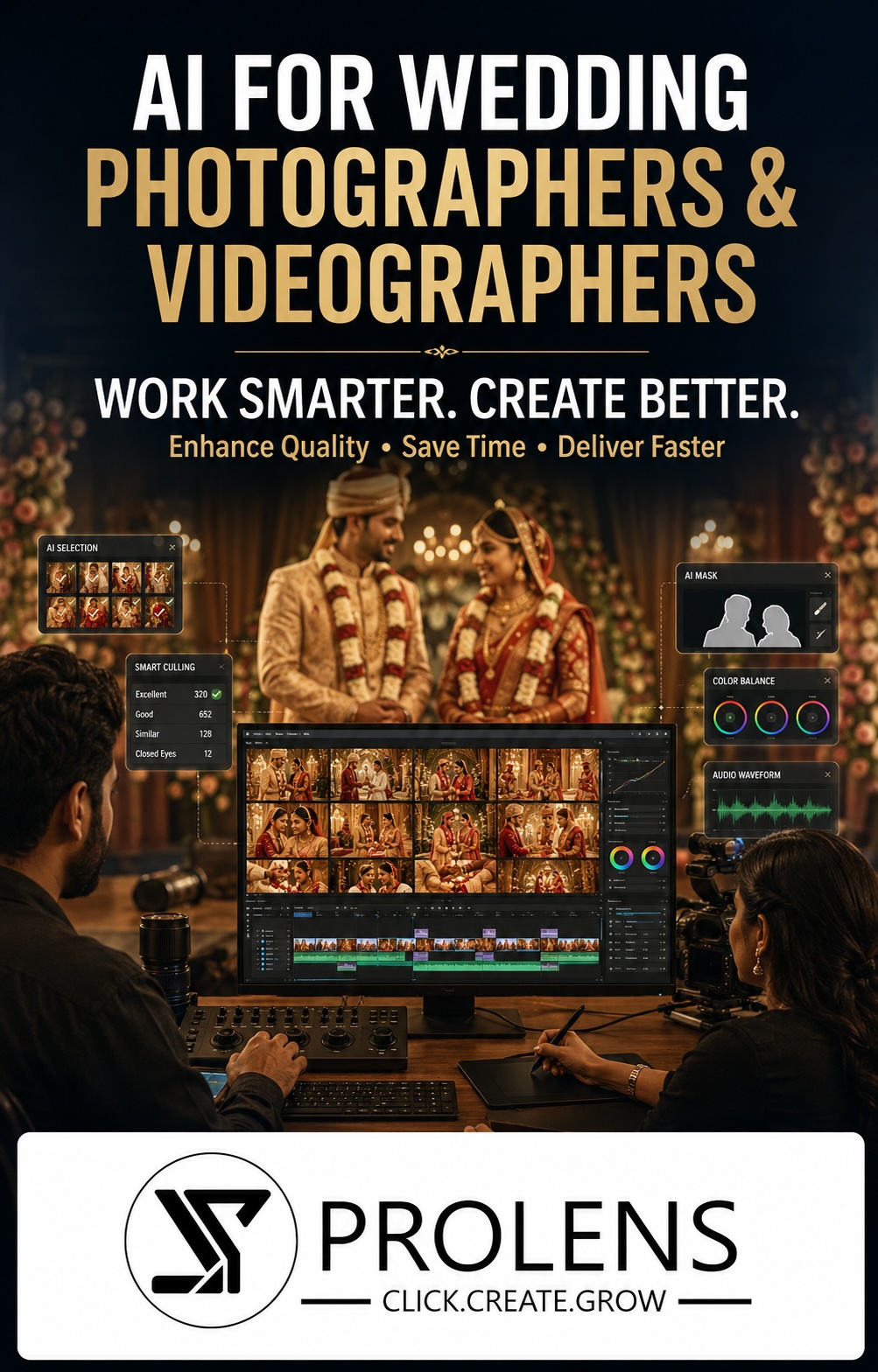
AI FOR WEDDING PHOTOGRAPHERS
AND VIDEOGRAPHERS
How Indian wedding professionals can improve quality, work faster and deliver a better client experience
A practical guide for Indian wedding photography and filmmaking studios
An Indian wedding is one of the most demanding assignments a photographer or filmmaker can undertake. It may involve several days of celebrations, multiple venues, hundreds of guests, fast-changing rituals, difficult lighting and tens of thousands of photographs and video clips.
Clients also expect more than a traditional album and wedding film. They want cinematic teasers, vertical reels, same-day edits, social-media photographs and fast delivery—without compromising quality.
This is where artificial intelligence can become a valuable creative assistant. Used correctly, AI does not replace the photographer’s eye, the filmmaker’s timing or the team’s understanding of people and traditions. It takes care of repetitive work, improves consistency and gives professionals more time to concentrate on emotion, storytelling and client service.
1. Before the wedding: better planning with AI
High-quality wedding coverage begins long before the cameras start rolling.
Understand the couple and their celebrations
AI can turn a client questionnaire, schedule and venue information into a structured brief. A studio can use it to prepare:
- a ceremony-wise photography and video checklist;
- a family group-shot list;
- a timeline for the bride, groom and camera teams;
- a list of important rituals and key people;
- equipment and lighting checklists for each venue; and
- backup plans for rain, delays or low-light conditions.
The output must always be checked by a team member. Indian wedding customs vary widely between regions, religions and families. AI may organise information, but the photographer must confirm the sequence and importance of every ritual with the couple or wedding planner.
Create visual references
Generative AI can help build moodboards for décor, couple portraits, colour palettes, lighting and reel styles. These references make pre-wedding discussions clearer and help align expectations.
They should be presented as inspiration—not as a guarantee that the final photographs will look identical. Real venues, weather, outfits, time and people will always influence the result.
Improve communication
AI can draft welcome emails, reminders, payment follow-ups, packing lists and multilingual instructions. Studios serving families across India can quickly adapt communication into Hindi or regional languages, but names, dates, cultural terminology and tone must be reviewed before sending.
2. During the wedding: intelligent tools behind the camera
Modern mirrorless cameras already use AI-based subject recognition, eye autofocus and tracking. These features are especially useful during varmala exchanges, dance performances, baraat movement and crowded ceremonies where subjects may be briefly obstructed.
Videographers can benefit from intelligent autofocus, active stabilisation and automatic subject tracking when working on gimbals. These tools improve the keeper rate, but they should not replace sound camera technique. Exposure, composition, lens choice, white balance and anticipation remain human responsibilities.
Use AI to support—not direct—the moment
The best wedding professionals read emotions before they happen. A camera may recognise an eye, but it cannot understand when a parent is about to become emotional, when a private glance matters or when a ritual is reaching its decisive moment.
Technology should help the team stay technically ready while the photographer or filmmaker remains fully attentive to the story.
3. After the wedding: faster and more accurate culling
A multi-day wedding can generate 20,000 or more photographs across several cameras. Reviewing every frame manually can take days.
AI-assisted culling software can group similar photographs, identify closed eyes, flag missed focus and detect duplicates. Face recognition can help locate important family members across different events. This gives the editor a faster first selection.
The final choice, however, should remain human. AI may select the technically sharpest image while missing the frame with the strongest emotion. A useful workflow is:
- Back up all cards before importing.
- Synchronise camera times and organise files by event.
- Let AI identify technical rejects and duplicate groups.
- Review every shortlisted sequence personally.
- Select for emotion, narrative variety and family importance.
- Keep a separate set for albums, reels and social media.
AI should reduce fatigue—not make the creative decisions.
4. Consistent photo editing at scale
Wedding photographers often work in mixed lighting: daylight, tungsten, LED stage lights and coloured décor illumination may all appear during one function. AI-assisted editing can help create consistency across thousands of files.
Useful applications include:
- automatic exposure and white-balance starting points;
- subject, skin, clothing and background masks;
- AI noise reduction for dark venues;
- removal of small distractions;
- matching colour and exposure across camera bodies;
- intelligent cropping and straightening; and
- sharpening and upscaling for large prints.
Protect natural Indian skin tones
Automated tools can easily over-smooth skin, brighten faces unnaturally or change the colour of sarees, lehengas and jewellery. Editors should compare AI suggestions with the RAW file and calibrated references.
The purpose is to improve the photograph—not to change the person. Retain real skin texture, accurate garment colour and the atmosphere of the venue. Generative edits that alter expressions, body shape, jewellery or meaningful details should only be made with the client’s knowledge and approval.
5. A stronger videography workflow
AI can save significant time across the wedding-film process.
Organise and find footage
Speech-to-text transcription can make interviews, vows and speeches searchable. Scene and face recognition can help editors locate the couple, family members, décor, rituals and establishing shots across many hours of footage.
Improve sound
AI audio tools can reduce background noise, improve speech clarity and balance dialogue levels. This is useful for vows, speeches and interviews recorded in crowded venues. Editors must listen carefully after processing; aggressive noise removal can make voices sound artificial.
Build faster first cuts
Transcripts, beat detection and automatic synchronisation can speed up multicamera editing. AI may help identify emotional statements or arrange a rough sequence, but pacing and storytelling should be decided by the filmmaker.
Repurpose the film intelligently
One master edit can be adapted into:
- a cinematic wedding film;
- a three-to-five-minute highlight;
- a 60-second vertical reel;
- short ceremony-specific clips;
- subtitled versions for silent viewing; and
- social-media teasers in different aspect ratios.
AI-powered reframing, captioning and clip discovery make this faster. Every output should still receive a visual and audio quality check before delivery.
6. Faster previews and better client experience
Speed matters, but uncontrolled automation can damage a studio’s reputation. A good approach is to use AI to prepare a small, carefully reviewed preview set within 24 to 48 hours.
AI can also help:
- organise online galleries by event and family group;
- identify photographs suitable for albums;
- prepare album-caption suggestions;
- draft personalised delivery messages; and
- answer common client questions through approved templates.
Online galleries should use passwords, expiry dates, download controls and watermarks where appropriate. Never upload private client photographs to an AI platform without understanding its privacy, retention and training policies.
7. Marketing the studio more effectively
Wedding professionals can use AI to turn one assignment into a structured marketing campaign. It can suggest blog titles, captions, keywords, reel hooks and posting calendars. It can also help prepare content in multiple languages for regional audiences.
The strongest marketing still comes from real work and real testimonials. Avoid presenting an AI-generated wedding scene as an actual assignment. If a visual is fully generated or significantly altered, label it clearly.
AI can improve presentation, but trust builds the brand.
8. What wedding professionals should never automate completely
Some parts of the workflow require direct human responsibility:
- understanding rituals and family priorities;
- choosing emotionally meaningful moments;
- final colour and skin-tone approval;
- music licensing and creative decisions;
- checking names, captions and translations;
- deciding what is appropriate to publish;
- handling private or sensitive client images; and
- final quality control before delivery.
AI can make a mistake confidently. A studio remains responsible for everything delivered under its name.
9. A practical AI workflow for an Indian wedding studio
| Stage | How AI can help | Human quality check |
| Enquiry | Draft responses and package summaries | Personalise the offer and confirm pricing |
| Planning | Create schedules, checklists and group-shot lists | Verify rituals, names and family priorities |
| Capture | Eye autofocus, tracking and stabilisation | Control exposure, composition and timing |
| Backup | Flag missing or duplicate files | Maintain verified copies in separate locations |
| Culling | Group duplicates and detect technical issues | Choose emotion and storytelling value |
| Photo editing | Masking, denoising and colour matching | Protect natural skin tones and accurate colours |
| Video editing | Transcription, sync, search and reframing | Shape narrative, pacing, sound and emotion |
| Delivery | Gallery organisation and message drafts | Review every exported file and privacy setting |
| Marketing | Captions, blogs and content variations | Publish authentic work with client permission |
10. Start small and measure the benefit
A studio does not need to automate everything at once. Begin with one repetitive task—such as culling, transcription or noise reduction—and test it on completed projects.
Compare:
- time saved per wedding;
- correction time after automation;
- consistency across the final delivery;
- client response;
- software and cloud-storage cost; and
- privacy risk.
Keep the tool only if it improves the finished work or the client experience. Faster is useful; better is the real objective.
The future belongs to AI-assisted storytellers
AI will not replace the qualities that make a wedding photographer or filmmaker valuable: empathy, cultural understanding, anticipation, visual judgement and the ability to make people feel comfortable.
It can, however, remove hours of repetitive labour and help a small studio deliver with the consistency of a larger team. The professionals who benefit most will use AI as an assistant—never as the author of the wedding story.
The formula is simple:
| Let AI manage repetition. Let the photographer and filmmaker create the emotion. |